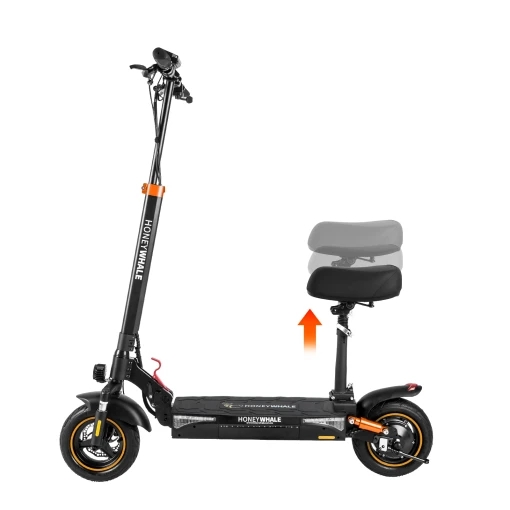

A buyer comparing electric scooters in New Zealand can run into a surprisingly awkward decision. One scooter is compact, easy to fold and clearly built for errands or short commutes. Another looks tougher, has larger tyres, more battery capacity, a stronger frame and far more motor output. On the screen, the more powerful model can seem like the obvious upgrade. In practice, that is not always how the decision works.
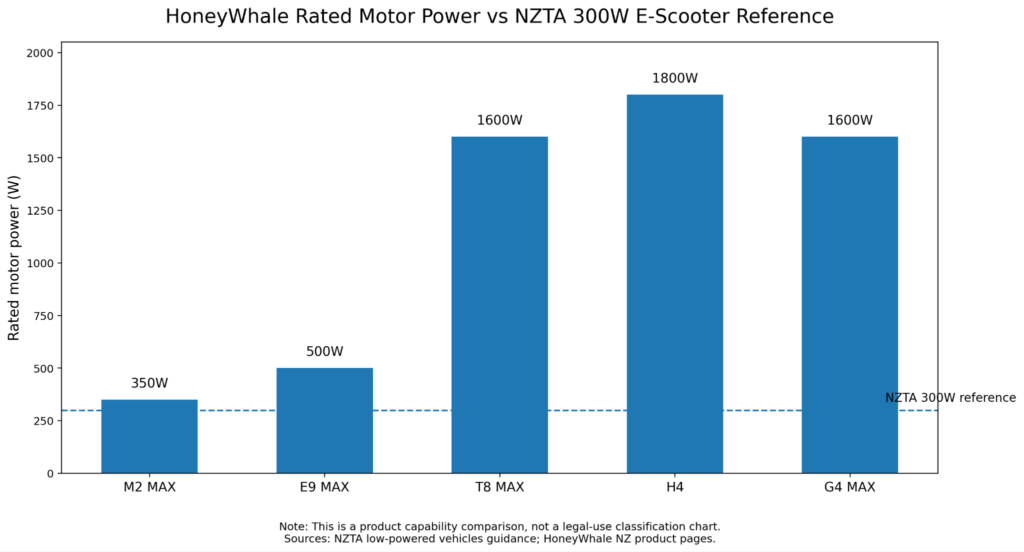
For local riders, motor power is not only a performance detail. It also sits beside classification, public-space use and the kind of trip the scooter is meant to handle. NZTA’s current e-scooter declaration renews the exemption for qualifying e-scooters until 30 September 2028 and describes the declaration as applying to e-scooters with a maximum power output of 300 watts that meet the other criteria in the notice (NZTA, 2023).
That does not turn every higher-powered scooter into a poor choice. It simply means the buyer has to ask a more precise question: am I buying for ordinary urban mobility, or am I buying a performance machine for a setting where that capability makes sense?
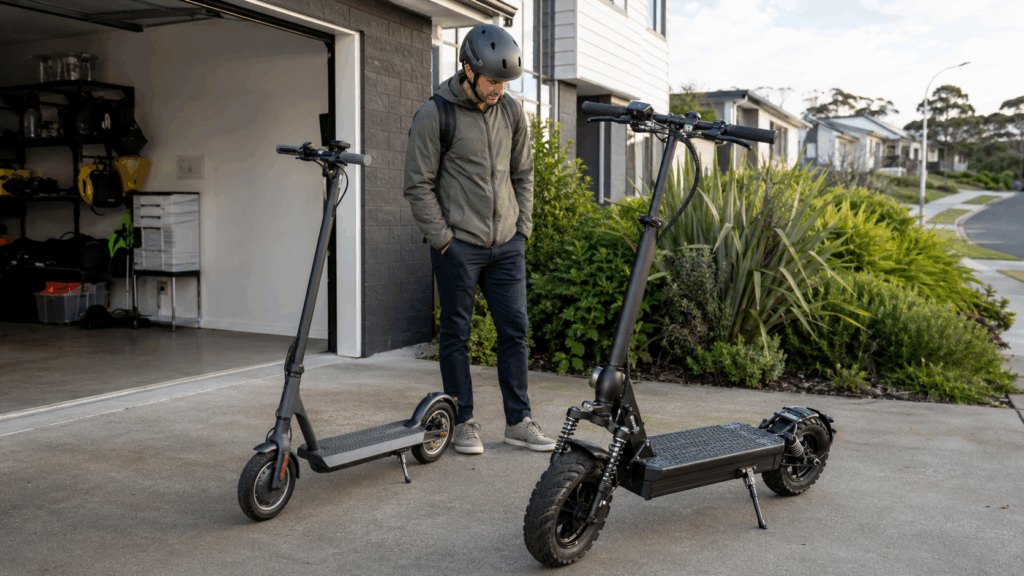
That distinction is where many product comparisons go wrong. A scooter with a bigger motor may be better for hills, off-road paths or private land. A lighter scooter may be better for carrying upstairs, storing at work or weaving carefully through a short daily routine. The right answer depends less on the largest number printed on the page and more on the route waiting outside the front door.
Why the 300W Figure Creates So Much Confusion
The 300W threshold matters because NZTA uses it in the requirements for certain e-scooters that are not treated as motor vehicles. NZTA’s low-powered vehicle guidance says some e-scooters do not need registration and can be used without a driver licence when they meet the listed design and power requirements, including wheels not exceeding 355mm in diameter and combined maximum motor output not exceeding 300W (NZTA, n.d.).
The same NZTA guidance says qualifying e-scooters may be used on the footpath or the road, but not in designated cycle lanes that form part of the road and are intended only for cyclists. It also says footpath users must ride carefully, avoid speeds that put others at risk and give way to pedestrians and mobility-device users (NZTA, n.d.).
Those details are easy to overlook when a buyer is focused on range, speed and price. Yet they shape the responsible way to describe scooter categories in New Zealand. A scooter may be available from a retailer, but that does not mean every public riding context is appropriate for it.
For HoneyWhale, the opportunity is to explain the choice without sounding defensive. The message should not be “power is bad.” The message should be “power belongs in the right context.” That is both clearer for customers and safer for the brand.
Rated Power and Peak Power Are Not the Same Thing
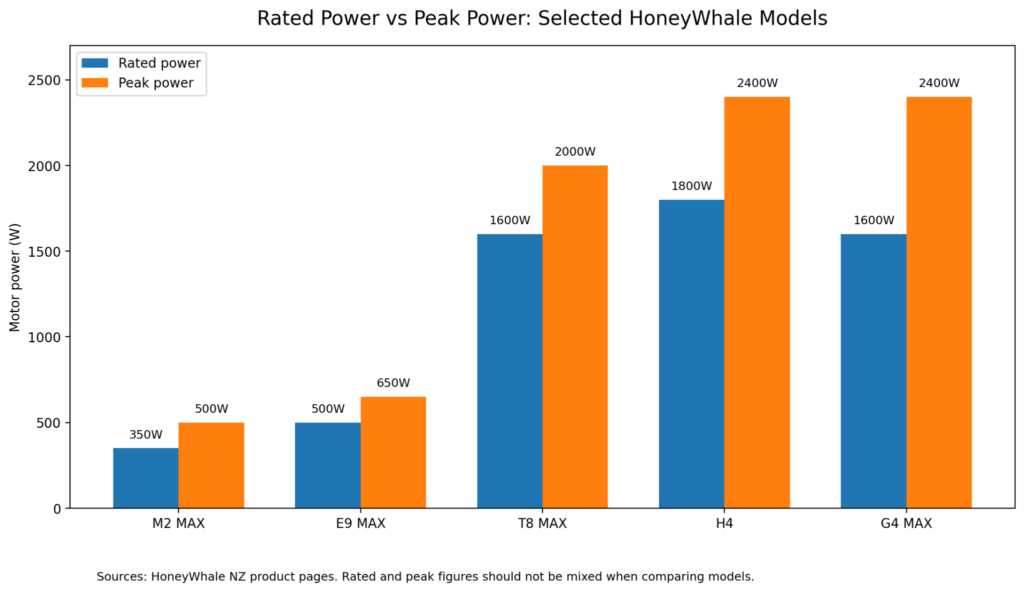
Another reason buyers get tangled is that scooter listings often use different power terms. NZTA notes that e-scooters have rated or nominal power and peak power, and it treats maximum power output as the rated or nominal output: the sustainable maximum the scooter can produce (NZTA, n.d.).
A peak figure is usually a temporary burst. It can help with acceleration or a short hill, but it is not the same as the motor’s sustained output. Rated power is closer to the number buyers should use when comparing one scooter with another.
This is where a lot of page-to-page comparisons become misleading. A model advertising a punchy peak output may still belong in a commuter category. A dual-motor scooter with high rated output belongs in a more demanding category. If those figures are treated as interchangeable, the buyer can easily overestimate what one scooter can do or underestimate how serious another one is.
The better retail explanation is simple: do not compare motor numbers until you know which number you are reading.
When a Lower-Powered Scooter Is Actually the Better Purchase
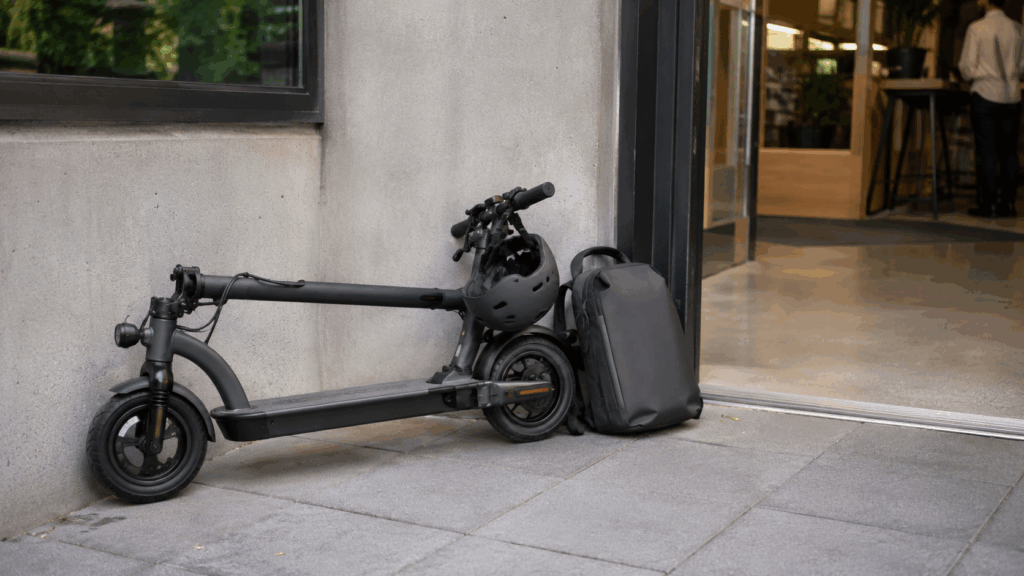
Plenty of New Zealand riders do not need a performance scooter. They need something that can cover a short distance reliably, fold without drama, fit inside an apartment and feel predictable after a long day. For this type of rider, extra power can become extra weight, extra bulk and extra cost.
HoneyWhale’s M2 MAX is a useful example of a commuter-leaning choice. Its product page lists a 32 km/h top-speed setting, up to 22 km range per charge, dual front and rear suspension, turning indicators, an easy-fold design, 8.5-inch pneumatic tyres, IPX5 water resistance and a 12 kg scooter weight (HoneyWhale, 2026a).
Those features speak to everyday handling more than raw aggression. A scooter that can be carried into a hallway or office is often used more consistently than a heavier machine that looks impressive but is awkward during the parts of the journey when nobody is riding it.
For a university student, a CBD worker or someone combining the scooter with public transport, that matters. A heavy scooter may win a specification comparison and lose the Monday morning test.
Where More Power Starts to Earn Its Place
The case for more power becomes stronger when the route asks more from the scooter. Hills, longer suburban distances, rougher pavement, heavier riders, wind and frequent stop-start riding all change the ownership experience. In those situations, the motor is only one part of the answer.
The better question is: what supporting hardware comes with that extra output? Tyres affect confidence. Brakes affect stopping control. Suspension affects fatigue. Battery capacity affects how useful the scooter feels once the route is no longer ideal. Lighting and indicators help the rider communicate with people around them.
HoneyWhale’s E9 MAX moves into a more capable urban category. Its official product page lists a 500W rated motor, 650W peak power, 540Wh battery capacity, 10-inch pneumatic tyres, front suspension, front and rear disc brakes, lighting and left/right indicators (HoneyWhale, 2026b).
That specification profile should not be explained as “more speed for everyone.” A more credible explanation is that some riders need a stronger platform for longer routes, hills or stability. The difference may sound subtle, but it changes the whole tone of the article.
A buyer who rides flat, short trips may never use the extra capability. A buyer dealing with a hilly suburb or a longer return journey may feel the difference every week. Matching the scooter to the use case keeps the recommendation useful instead of simply expensive.
Performance Scooters Need Their Own Category
High-power scooters should not be described as if they are ordinary commuter scooters with a louder motor. They are usually heavier, faster and more demanding. They often make more sense for experienced riders, controlled routes, off-road environments or private-property use where the rider understands the machine and the setting.
The T8 MAX is a good example of a model that should be discussed in performance language. HoneyWhale lists it with 2000W peak power, 1600W rated power, switchable single/dual-motor use, 12-inch off-road tubeless tyres, dual front and rear shock absorbers, disc and hydraulic brakes, IPX5 water resistance and a 33 kg weight (HoneyWhale, 2026c).
The H4 is even more clearly positioned as an off-road-style performance scooter. Its product page lists 2400W peak power, 1800W rated power, 11-inch tubeless tyres, front and rear spring suspension, front and rear disc plus electronic braking, a 43 kg weight and a top-speed setting up to 70 km/h under stated conditions (HoneyWhale, 2026d).
These are meaningful features, but they require careful editorial framing. They belong in content that talks about rider experience, terrain, braking, weight, transport, storage and the difference between product capability and permitted use. Otherwise, the article risks making the performance category look like a simple upgrade ladder.
It is better to be plain: a performance scooter may be the right tool for the right rider, but it is not the automatic answer for every New Zealand buyer.
The Buyer Framework HoneyWhale Should Use
A practical New Zealand buyer framework should start with the route, not with the motor.
For short errands, flat routes and mixed transport, the buyer should first look at weight, folding design, brake feel and whether the scooter is easy to store. The motor still matters, but it should not dominate the decision.
For hillier suburbs or longer adult commuting, the buyer should compare battery capacity, tyre size, braking hardware, suspension and whether the model remains comfortable at the end of the trip. A scooter that feels fine for five minutes may not feel the same over repeated weekly use.
For private-property or off-road performance, the buyer should move into a separate comparison set. Larger tyres, stronger suspension, higher weight, more braking hardware and dual-motor capability can become more relevant, but the rider must also think about where the scooter will be used and how it will be transported.
HoneyWhale’s G4 MAX illustrates that upper performance tier. Its product page lists dual motors with 1200W x 2 peak power, 1600W rated dual motor output, 12-inch off-road tyres, front and rear spring suspension, front and rear disc brakes, lighting, left/right indicators and a 36 kg weight (HoneyWhale, 2026e).
That is a different conversation from helping someone choose a first scooter for short daily rides. Putting both categories into the same buying bucket creates confusion. Separating them builds trust.
What This Means for Internal Linking
This article should not link to every product with the same wording. Internal links should reflect the stage of the buyer’s decision.
When the article talks about portability and short rides, it should link to commuter-focused models such as M2 MAX, E9 Pro or E9T. When it discusses longer urban routes, hills and stability, it can link to E9 MAX, M1 MAX, M2 MAX-B or relevant T-series models. When it discusses private-property or off-road performance, it can link to T8 MAX, H4 and G4 MAX with clear contextual language.
That structure helps search engines understand the product range and helps readers avoid the feeling that the article is pushing one model regardless of need.
Final Advice for New Zealand Buyers
The smartest way to choose an electric scooter in New Zealand is not to start with the biggest motor figure. Start with the ride you actually expect to do.
A compact commuter scooter may be the better tool for a short, repeatable daily route. A more capable urban scooter may suit riders who need greater comfort, braking and battery capacity. A high-power model may suit experienced riders who want a performance machine for suitable environments and who understand the difference between specification and riding context.
That is the key point for HoneyWhale to own in this topic: the best scooter is not the one with the largest number on the spec sheet. It is the one whose weight, motor, tyres, brakes, battery and intended use line up with the rider’s real life.
When the article is framed that way, the 300W question stops being a narrow legal detail and becomes a better buying conversation.
References
HoneyWhale. (2026a). M2 MAX electric scooter product page.
HoneyWhale. (2026b). E9 MAX electric scooter product page.
HoneyWhale. (2026c). T8 MAX electric scooter product page.
HoneyWhale. (2026d). H4 off-road electric scooter product page.
HoneyWhale. (2026e). G4 MAX electric scooter product page.
NZ Transport Agency Waka Kotahi. (2023). E-scooter declaration renewal decision.NZ Transport Agency Waka Kotahi. (n.d.). Low-powered vehicles.