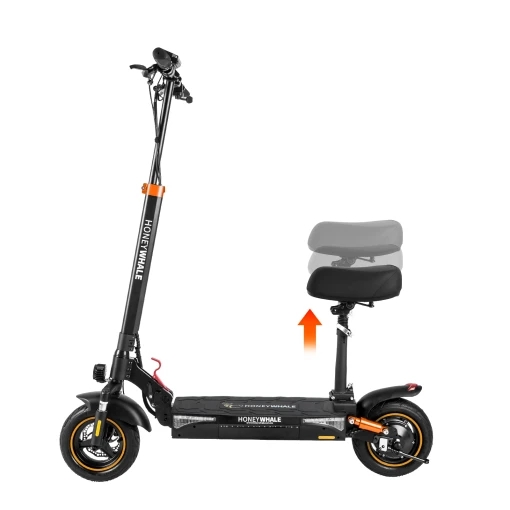

You can usually tell when an electric scooter has been ignored for a while.
Not because it suddenly gives up in the middle of the road. More often, it just starts feeling a bit tired. The front end has a small knock over rough concrete. The brake still works, but not quite as sharply. The rear tyre looks fine until you press it with your thumb and realise it is softer than it should be.
That is the kind of maintenance most riders put off.
And in New Zealand, where a dry morning can turn into a wet ride home, putting it off is usually what causes the annoying stuff later: weak braking, poor range, loose folding parts, water sitting where it should not, or a battery that has been stored badly for weeks.
HoneyWhale’s own Maintenance & Care page takes a practical line on this. It says many after-sales issues come from avoidable wear and tear, then breaks care down into ordinary checks: tyres, brakes, cleaning, bolts, charging, folding parts and storage (HoneyWhale, n.d.). That is the right way to think about scooter maintenance. Not as a big technical job. More like a habit you repeat before small problems grow teeth.

Start With the Parts That Change How the Scooter Feels
A scooter can be useful and still have a few scuffs, old grip tape, or a deck that has clearly seen some weather. That is normal. What you do not want is a scooter that feels vague under your hands or feet.
I would start with the parts that decide the ride before anything else: tyres, brakes, the stem, the handlebar and the folding lock. Not the app. Not the range estimate on the display. Those can wait.
Before rolling out, I like to do the checks in the order I would actually feel them on the road. Brake first. Then tyres. Then anything that might move when it should not.
Give the brake lever a squeeze and notice whether it catches in the usual place. Walk around the scooter if there is space and look at both tyres, especially the rear one. It is easy to miss. Then hold the bar, rock it gently, and check that the folding lock is fully seated. If something scrapes or clicks in the first few metres, make a mental note before you forget it.
HoneyWhale lists brake response as a before-ride check, while tyre pressure, cracking and wear sit in the every-two-weeks-or-200km category. I would treat that as a baseline rather than a strict ceiling. A scooter used daily around town simply gets knocked around more than one that comes out on the weekend (HoneyWhale, n.d.).
Tyres: The Boring Check That Fixes More Than People Expect
Tyres are easy to ignore because they usually fail slowly.
A battery problem feels like a big-ticket issue, so riders often blame the battery first when a scooter starts feeling lazy. Sometimes they are right. Quite often, though, the tyre is just soft enough to make the scooter feel heavier than it should.
You feel it before you see it. The scooter rolls with a little more drag. Corners feel dull. Acceleration loses its edge. It is not dramatic, which is why people ride on it for too long.
Start with the cheap check before assuming the expensive one.
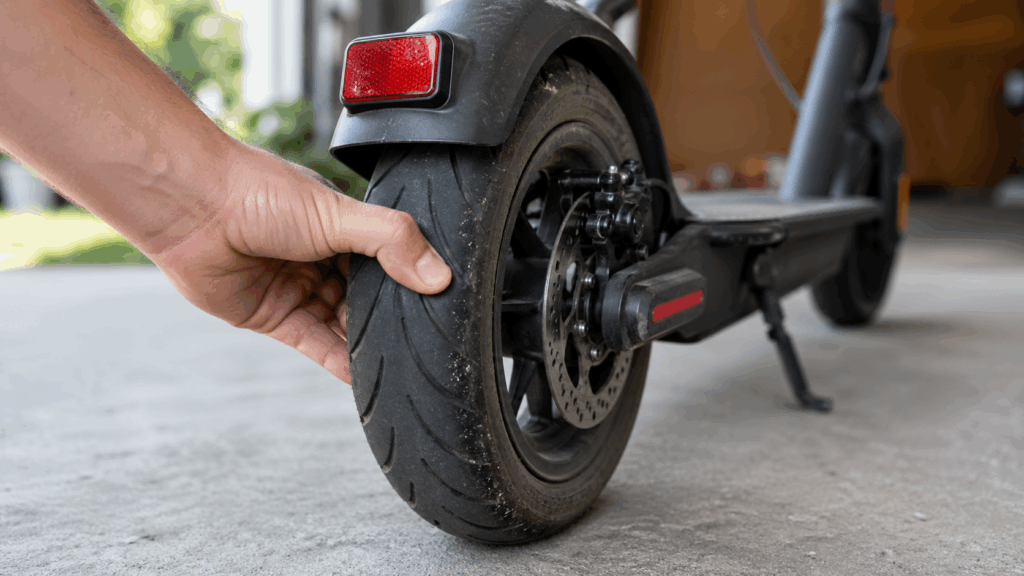
Press the tyre with your thumb, then roll the scooter slowly and watch the tread. Look for little cuts, flat-looking patches, uneven wear, or a bit of glass or stone that has worked its way in. A tyre that keeps going soft after you inflate it is not “just one of those things”. It deserves a closer look, especially before a longer ride or a wet commute.
HoneyWhale’s own FAQ points riders back to tyre pressure when a scooter starts feeling slow, which is a useful reminder because not every sluggish ride is a battery fault (HoneyWhale, n.d.).
Brakes: Do Not Wait Until They Feel Bad
Brake problems rarely feel dramatic at first.
A little squeak. A lever that pulls slightly further in. A stop that takes half a second longer than expected. None of it feels urgent until the day you need the scooter to stop quickly.
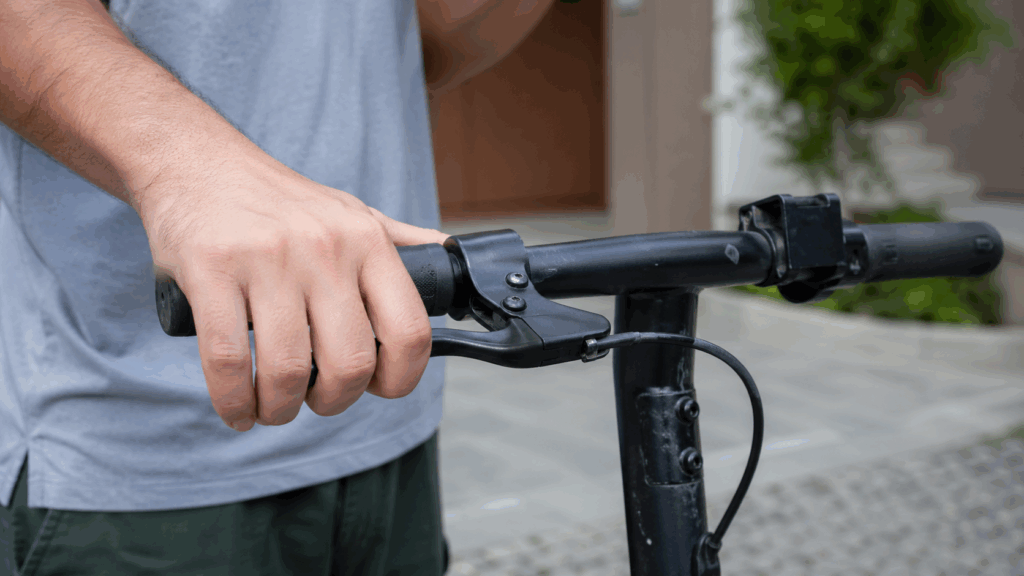
Brake feel is one of those things riders learn by repetition. If the lever suddenly pulls further than usual, or the scooter needs more distance to slow down, something has changed.
HoneyWhale’s care guidance tells riders to test brake response, adjust brakes that feel soft or squeaky, and replace worn pads when needed. I would treat that as a minimum, not a nice-to-have. A scooter that does not stop cleanly should not be talked into “just one more ride” (HoneyWhale, n.d.).
Wet roads, dust and worn pads can all change how braking feels. A brief squeak after a damp ride may not be a crisis. A soft lever or delayed stop is different.
For heavier or performance-focused scooters, brake care becomes even less optional. More weight and speed ask more from the braking system, especially on hills. The same rider who can get away with lazy checks on a slow, short-range scooter may not get away with it on a more powerful model.
The test is not complicated: does it stop the way you expected?
If the answer is no, stop and check.
Battery Care Is Mostly About Avoiding Bad Habits
Battery care is often made to sound more technical than it needs to be.
Most of it comes down to avoiding a handful of bad habits: running the scooter flat again and again, leaving it empty for weeks, charging in a damp place, storing it somewhere hot, or using a charger simply because the plug fits.
HoneyWhale advises regular charging, avoiding full discharges, and keeping the battery around 50–70% if the scooter will sit unused for a while. That storage point is easy to overlook. The scooter gets parked during a run of bad weather, or left while someone is away, and the battery is expected to behave as if no time has passed. Batteries are not quite that forgiving (HoneyWhale, n.d.).
The same common-sense pattern shows up in Fire and Emergency New Zealand’s lithium-ion battery guidance. Use the charger supplied with the device, or certified compatible gear with the right voltage and current. Do not leave batteries charging longer than needed. Disconnect once charged. None of that is exotic advice, but it is the kind of ordinary habit that gets skipped when charging becomes automatic (Fire and Emergency New Zealand, 2026).
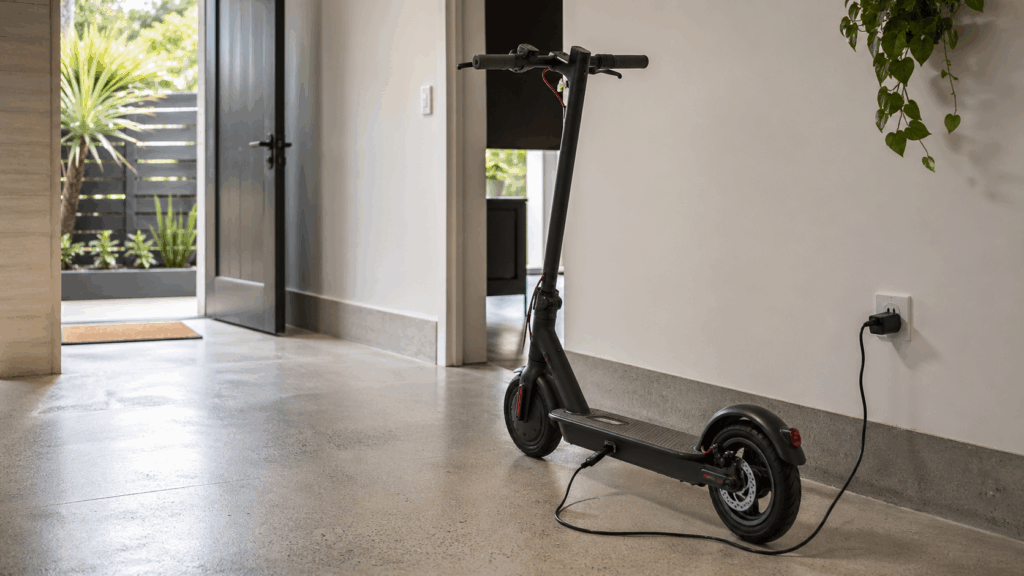
For most riders, the charging setup should pass a simple glance test: dry area, correct charger, no heat trap, no blocked exit, no mystery cable.
Bolts, Stem and Folding Lock: The Part Riders Forget Until It Rattles
If tyres and brakes are the obvious checks, bolts are the neglected ones.
Scooters vibrate constantly. They go over driveway edges, rough asphalt, tactile paving, patched footpaths and the odd pothole that appears too late to avoid. After enough of that, small parts can loosen.
Usually, the first sign is not visible. It is a sound.
A faint rattle near the stem. A creak when braking. A folding latch that does not feel as firm as it used to. These are easy to ignore because the scooter still rides. But they are also exactly the kind of early warning signs that maintenance is supposed to catch.
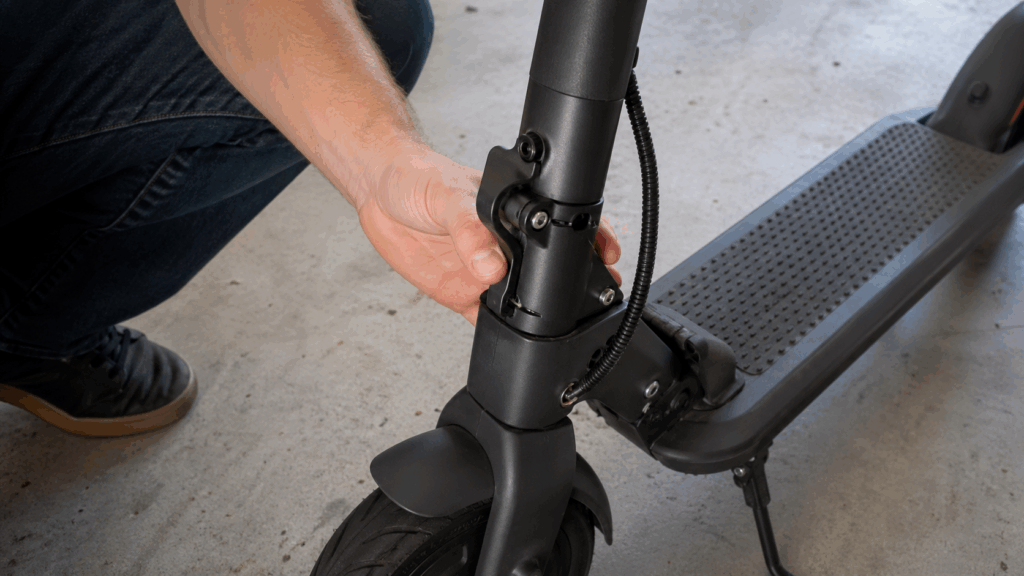
HoneyWhale recommends weekly checks of the handlebar, stem and folding lock, tightening loose parts where needed. The key phrase is “where needed”. This is not an invitation to attack every screw with maximum force. Over-tightening can create its own problems (HoneyWhale, n.d.).
A better habit is slower. Hold the handlebar. Gently test for movement. Check the folding lock properly engages. Look for missing fasteners. Pay attention to new noises.
If the scooter has model-specific maintenance videos available, use them. Generic advice is useful up to a point; folding mechanisms and fasteners can vary by model. HoneyWhale’s Maintenance & Care page includes video support for several models, including the C1 Pro, E9 Max, E9 Pro, G2 Pro, M2 Max, M2 Max B and T4-A/T4-B (HoneyWhale, n.d.).
Wet Roads Are Normal. Wet Storage Should Not Be.
New Zealand weather makes scooter care slightly less tidy than the manuals pretend.
You may leave home on dry pavement and come back through drizzle. The road may be wet even when the rain has stopped. The scooter may collect grime around the deck, stem and brake area. None of that is unusual.
The mistake is parking it wet and forgetting about it.
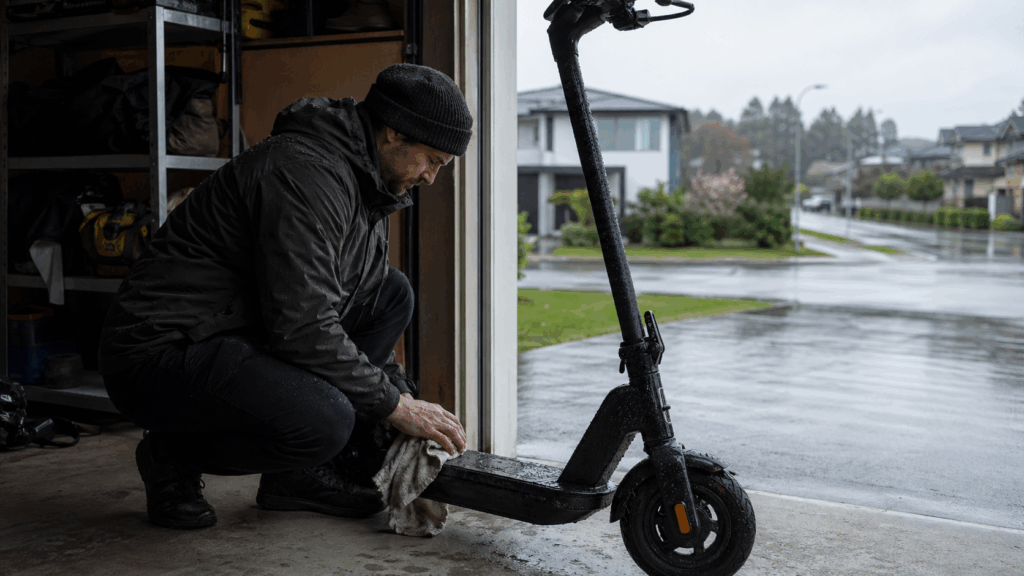
HoneyWhale advises riders to dry the scooter after rain use and not store it wet. It also recommends cleaning with a damp cloth rather than spraying water directly onto the motor or battery. That last part matters. An electric scooter is not a mountain bike. Hosing it down because it looks dirty is not “maintenance”; it is asking water to go places it should not (HoneyWhale, n.d.).
There is also a practical difference between a damp ride and riding through standing water. A bit of wet road is one thing. Deep puddles, heavy rain and water forced into the wrong parts are another.
After a wet ride, wipe the deck, stem, folding area and brake area. Let the scooter dry before charging. If the charging port or surrounding area is damp, wait.
It is a small pause. Worth it.
Charging at Home: Keep the Exit Clear
A lot of scooters get charged wherever they happen to stop.
Front door. Hallway. Under a desk. Beside shoes, bags and everything else that lives near the entrance. It is convenient, which is probably why people do it.
The problem is the exit.
FENZ’s advice is basically about keeping escape routes usable and batteries away from places where heat, moisture or clutter make a bad situation worse. It recommends charging e-scooters and e-bikes away from exits, and where possible, storing or charging them outside, in a garage, shed or carport rather than in the middle of living space (Fire and Emergency New Zealand, 2026).
Of course, not every rider has a garage. Plenty of people live in apartments or small flats. In that case, the realistic goal is not perfection; it is reducing the obvious risks. Keep the scooter out of direct sun. Do not charge on soft surfaces. Keep the area dry. Keep the doorway clear. Do not leave it in a hot parked car and call that storage.
Heat, swelling, smoke, fumes or a burning smell are different. At that point, you are no longer dealing with a maintenance annoyance. FENZ says people should evacuate, call 111 from a safe place and not re-enter the building if a battery or device is smoking, on fire or releasing fumes (Fire and Emergency New Zealand, 2026).
That is where the screwdriver goes away and the emergency call matters.
When a Scooter Should Not Be Ridden
Some faults are annoying. Others are stop signs.
Brake delay, a loose folding lock, movement in the stem, an electrical smell, battery heat, serious water exposure or grinding from the wheel area all deserve more than a quick shrug. The same is true after a crash. A scooter can still power on while something underneath has shifted, cracked or loosened.
I would draw the line around five areas: stopping, steering, folding, battery behaviour and structural stability. If the issue touches any of those, do not test it on the next hill or commute.
Basic cleaning, tyre checks and a visual bolt check are fine at home. Guessing through wiring, battery symptoms or folding mechanism damage is not. That is where model-specific support matters more than general internet advice.
HoneyWhale’s Maintenance & Care page includes model-specific support for several scooters, including the E9 Max, E9 Pro, G2 Pro, M2 Max and T4 series. Use that support early, while the issue is still small (HoneyWhale, n.d.).
Maintenance Is Not the Same as Road Legality
A scooter can be clean, charged, tightened and still not be suitable for every public riding situation.
That distinction matters in New Zealand.
The legal side is separate from the maintenance side, and it is worth not mixing them up.
NZTA’s low-powered vehicle guidance sets out the conditions for e-scooters that do not need registration or a driver licence. The details include a footboard, two or three wheels, a long steering handle, wheels no larger than 355mm, and combined maximum motor power not over 300W. NZTA also explains where qualifying e-scooters may be used, including footpaths and roads, with limits around cycle-only lanes that form part of the road (NZ Transport Agency Waka Kotahi, 2026).
The separate declaration page confirms that the relevant e-scooter declaration has been renewed until 30 September 2028 (NZ Transport Agency Waka Kotahi, 2023/2026).
So the rider has two jobs, not one: keep the scooter in decent condition, and check that the way it is used fits the rules.
One is condition: brakes, tyres, battery, bolts and folding parts.
The other is compliance: where the scooter can be used and whether it fits the rules.
Good maintenance helps with the first one. It does not automatically solve the second.
The Maintenance Schedule Worth Keeping
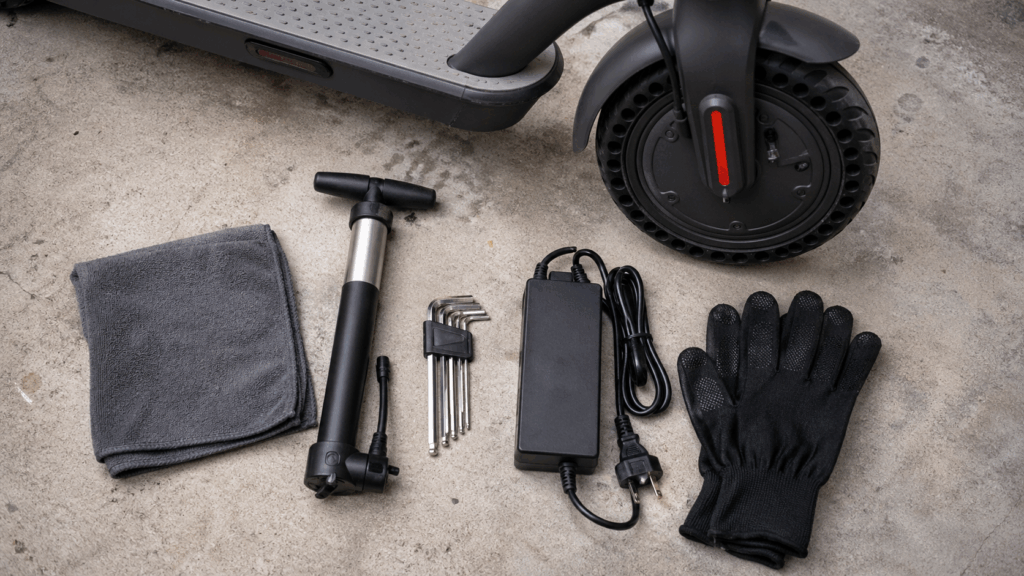
This is the only checklist most riders really need to save.
| Frequency | What to Check |
| Before every ride | Brake response, tyre condition, steering feel, folding lock and unusual sounds |
| After wet rides | Dry the scooter before storing or charging it |
| Weekly | Wipe down the scooter, check visible bolts, handlebar, stem and folding lock |
| Every 2 weeks or 200km | Check tyre pressure, cracks and wear |
| Every 1–2 months | Inspect folding parts and moving joints more carefully |
| Before long-term storage | Store battery around 50–70%, keep the scooter dry and away from heat |
| Any time something feels wrong | Stop riding and inspect before continuing |
Nobody keeps up with maintenance perfectly. That is probably fine. Scooters are used in real weather, by real people, often when they are running late.
What matters is noticing the changes that repeat. A tyre that keeps going soft. A brake lever that feels different from last month. A new rattle near the stem. A scooter that comes home wet and keeps getting parked that way. A battery that is always charged in the most convenient, least sensible corner of the house.
Fixing those habits is where most useful maintenance begins.
For model-specific help, visit HoneyWhale’s official Maintenance & Care page for maintenance videos and practical care guidance. If you are choosing a scooter for regular commuting, compare current HoneyWhale models such as the E9 Pro, E9 Max N, M2 Max, T8 Max and G2 Pro, then match the model to your route, storage situation and willingness to maintain it properly.
References
- Fire and Emergency New Zealand. (2026). Lithium-ion battery safety. Fire and Emergency New Zealand.
- HoneyWhale. (n.d.). Maintenance & Care: Keep your e-scooter & e-bike in top condition. HoneyWhale New Zealand.
- NZ Transport Agency Waka Kotahi. (2026). Low-powered vehicles.
- NZ Transport Agency Waka Kotahi. (2023/2026). E-scooter declaration renewal decision.