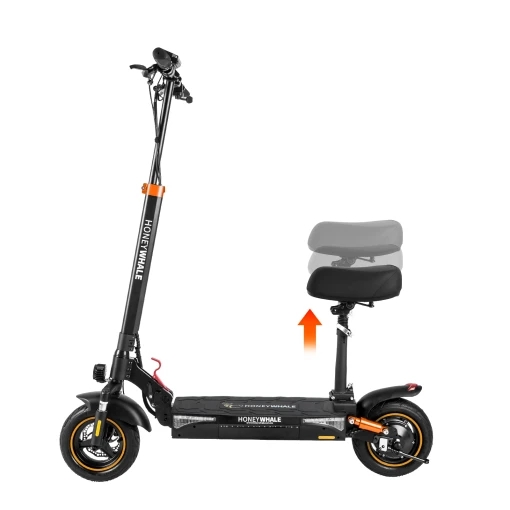

Rain usually arrives halfway through the errand, which is rude but very New Zealand. You roll out on a dry path. Two driveways later the concrete has gone dark, the painted kerb looks slick, and the scooter under your shoes feels a touch more nervous than it did at the gate.
Nothing dramatic has happened. That is exactly why riders get casual.
So, can you ride an electric scooter in rain NZ? For ordinary drizzle and damp streets, sometimes yes. The better answer is less tidy: the scooter needs to be built for normal wet use, and the rider needs to stop treating the trip as if the surface stayed dry.
This article takes the boring middle position. It will not pretend a water-resistant scooter is a submarine. It will also not suggest that every shower should cancel a commute. The useful space sits between those extremes.
Start by Naming the Kind of Rain
The phrase “riding in rain” hides three different situations. A ten-minute drizzle on sealed pavement is one. A winter commute through standing water is another. Leaving a scooter outside during a downpour is another again.
Those rides should not be judged together.
Light spray on the deck and stem is the sort of condition many commuters eventually meet. Deep puddles push water upward into places that were never meant to be wet. Mud adds grit, which is less exciting than water but often more annoying later, because it finds moving parts and stays there.
The legal side does not vanish when the weather turns. NZTA’s low-powered vehicle guidance says qualifying e-scooters can be used on the footpath or road, with limits around cycle lanes and with care expected around pedestrians. In wet weather, that care becomes less theoretical. A footpath shared with a dog walker, a pram and a slick driveway crossing gives a rider very little room for bravado.
A sensible wet ride begins before the throttle is touched: look at the ground, not just the sky.
Water Resistance Is a Clue, Not a Promise
New Zealand shoppers often type “waterproof electric scooter NZ” into search because it feels like the safest word. It is also the word that causes trouble.
A scooter may resist splashes without being happy about submersion. It may handle damp streets without enjoying a hose, pressure washer, flooded gutter or a night outside in sideways rain. A rating can help a buyer filter options, but the warranty language and the brand’s support policy usually tell the more useful story.
For example, the HoneyWhale M2 MAX page lists IPX5 water resistance alongside commuter features such as pneumatic tyres, suspension, lighting and indicators. That mix is more useful than a loud “waterproof” claim on its own.
The HoneyWhale E9 MAX belongs in the same sort of conversation for riders who want a larger commuter platform, bigger tyres and more braking hardware. Again, the point is not to sell rain as harmless. It is to make the buyer read the whole scooter, not one line of the spec sheet.
A cautious phrase on a product page can be a good sign. It means somebody has thought about the awkward situations, not only the sunny ones.
What the Ground Does to the Ride
Rain makes ordinary surfaces change personality. The painted strip at a crossing, a metal service cover, wet leaves by a driveway, smooth concrete outside a shop — none of these need to look dangerous to become slippery.
The first fix is not technical. Enter turns slower. Brake before the corner. Keep the scooter upright when the rear wheel is passing over anything glossy. Leave the tiny heroic lean angles to people who enjoy replacing parts.
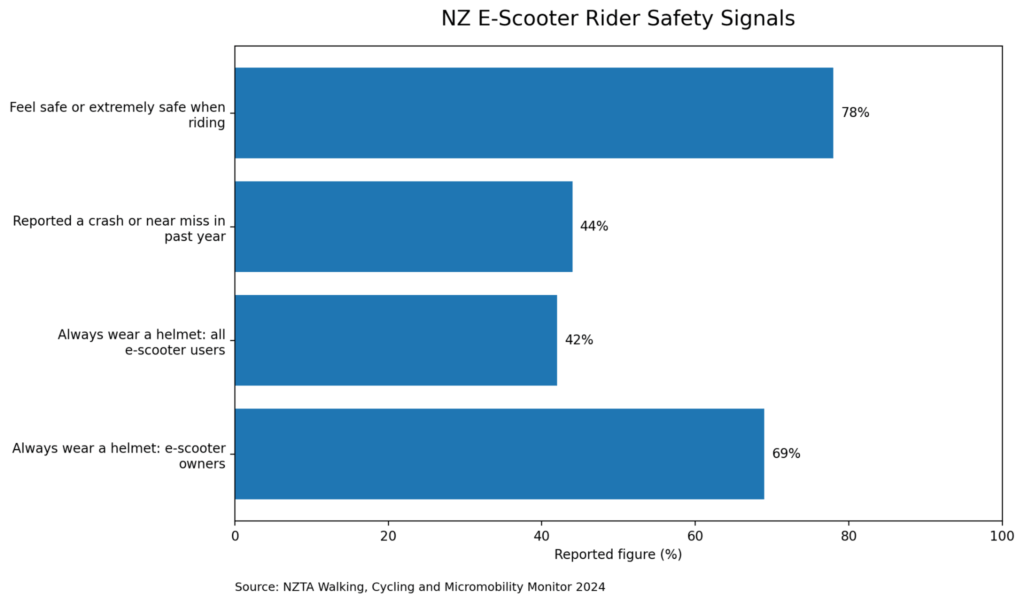
ACC’s topical statistics page publishes e-scooter injury-claim data and includes caveats about how those figures should be read. That caveat is useful here. Rain should not be blamed for every incident, but wet surfaces are one of those everyday conditions where better habits have a chance to prevent a small mistake from becoming expensive.
That is a modest claim, and it is the right one.
Tyres Earn Their Keep in Winter
Many buyers compare scooters by speed first. Rain rewards a different habit.
Tyres are the part having the conversation with the road. Pneumatic tyres can soften harsh pavement and help the scooter feel less skittish over joins, chip seal and small bumps. Larger tyres can feel calmer when the surface is uneven. All-terrain tyres have their place on rougher private surfaces, but they do not turn wet sealed roads into dry ones.
This is why a smaller commuter scooter and a bigger performance scooter should not be ranked only by power. They solve different problems. A light model may be easier to carry into an apartment after a wet ride. A larger model may feel more planted on rougher ground, but it also asks more from the rider.
The HoneyWhale T8 MAX and HoneyWhale G4 MAX sit in a heavier performance conversation, with larger tyres and stronger component packages. For rain content, they should be framed carefully: useful for experienced riders and suitable environments, not as a shortcut for careless wet commuting.
Wet weather is not an invitation to buy more power. It is a reminder to buy the right platform for the route.
Brakes and Lights Are Dull Until They Aren’t
Nobody gets excited about braking distance in a showroom. In drizzle, that changes.
A brake setup should match the scooter’s weight and speed category. A compact commuter does not need the same system as a heavy dual-motor machine, but every scooter should stop in a way that feels predictable. Grabby braking can be almost as unsettling as weak braking when the surface is shiny.
Use both the equipment and the space. Start slowing earlier. Avoid sudden throttle while turning. Give parked cars and driveways extra respect, because a driver’s view through a wet windscreen is not your friend.
Lighting belongs in the same unglamorous bucket. The HoneyWhale T8 page, for instance, lists lighting and indicators among its features, which is worth mentioning in winter content because rain and low light often arrive together. Indicators do not replace shoulder checks or judgement, but they reduce the amount of guessing other people have to do.
On a wet afternoon, being obvious is underrated.
After the Ride, Wait Before Charging
The most overlooked part of a rainy scooter trip happens after the scooter is folded.
A damp deck is not a crisis. A wet charging port, a soaked stem, or a scooter that has gone through deep water deserves more caution. Wipe it down. Let it sit somewhere ventilated. Check the charge area before plugging anything in. If water has reached places it should not reach, treat that as a service question rather than a normal commute.
Fire and Emergency New Zealand’s lithium-ion battery safety guidance is blunt about the home side of ownership: use the supplied or compatible certified charger, avoid overcharging, keep e-scooters and e-bikes away from exits where possible, and do not turn an escape route into a charging bay.
Apartment riders have the hardest compromise. The hallway is convenient. The hallway is also where people leave in a hurry if something goes wrong. A garage, shed or carport is not always available, but the principle still helps: charge on a dry, stable surface, away from soft furnishings and doorways, and unplug once charging is complete.
That advice is not glamorous. It is also not optional housekeeping. It is part of owning a lithium-ion device that lives near rain, road grit and daily shortcuts.
A Buyer’s Shortlist for Damp New Zealand Routes
If the weekly route includes drizzle, wet driveways or early starts in winter, shop in this order.
First, look for honest water-resistance wording. Second, check tyre type and size. Third, match the brakes to the scooter’s weight. Fourth, make sure the lights and indicators are more than decorative. Fifth, ask where the scooter will dry and charge at home.
Only after that should speed and headline range take over the conversation.
For short urban trips, HoneyWhale M2 MAX is the sort of model to compare when portability matters. For riders wanting a more substantial commuter feel, HoneyWhale E9 MAX is a more natural comparison. If the route moves toward private-property performance, rougher surfaces or heavier-duty use, HoneyWhale T8 MAX and HoneyWhale G4 MAX belong in a separate discussion.
The separation is important. A scooter that is excellent in one setting can be a nuisance in another.
| HoneyWhale Model | Wet-Weather Feature to Notice | Best-Fit Use Case |
| HoneyWhale M2 MAX | IPX5 water resistance, pneumatic tyres, suspension, indicators | Short urban rides and portable commuting |
| HoneyWhale E9 MAX | IPX5 water resistance, 10-inch tyres, front and rear disc brakes, indicators | Longer commuter routes and riders wanting more stability |
| HoneyWhale T8 MAX | Larger all-terrain tyres, suspension, higher-performance braking setup | Experienced riders comparing heavier performance scooters |
| HoneyWhale G4 MAX | Larger tyre platform, suspension and performance-focused specification | Private-property or performance-oriented comparison |
Small Habits That Save Wet Scooters
A wet-weather routine should be short enough to actually happen.
Wipe the deck and stem. Keep mud away from folding points and brakes. Do not pressure-wash the scooter. Listen for new rubbing or clicking after gritty rides. Check tyre pressure more often in winter if the ride begins to feel vague. If the brake lever travel changes, do not hope it fixes itself.
The same goes for storage. A scooter parked wet by the front door may seem harmless for one night. Do it all season and small problems get more chances to grow. Dry, boring storage beats heroic aftercare.
Final Word: Light Rain Can Be Manageable; Casual Rain Riding Is the Problem
So, can you ride an electric scooter in the rain in New Zealand?
For light rain and damp roads, often yes — if the scooter is suitable, the rider slows down, and the post-ride routine is sensible. Heavy rain, floodwater, mud, poor visibility and wet charging are different matters.
Look past the word “waterproof.” Ask about water resistance, tyres, brakes, lights, indicators, local support and where the scooter will be charged after the ride.
That is a less flashy way to buy an electric scooter. It is also the one that still makes sense when the pavement gets wet.
References
Waka Kotahi NZ Transport Agency. Low-powered vehicles.
Accident Compensation Corporation. Topical statistics.
Fire and Emergency New Zealand. Lithium-ion battery safety.
HoneyWhale. M2 MAX electric scooter product page.
HoneyWhale. E9 MAX electric scooter product page.
HoneyWhale. T8 electric scooter product page.
HoneyWhale. T8 MAX electric scooter product page.
HoneyWhale. G4 MAX electric scooter product page.