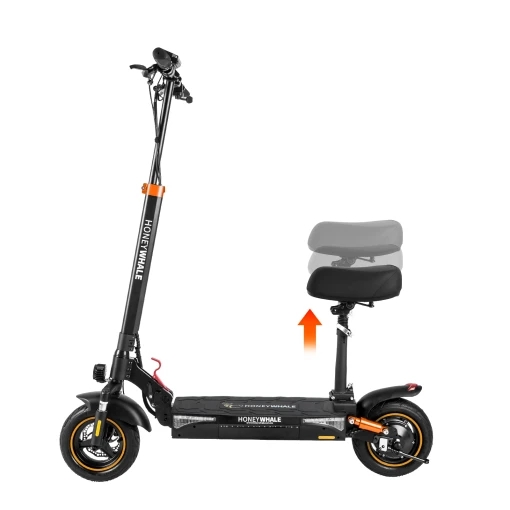

Auckland Transport allows e-scooters on buses and ferries, but not on the same terms. A bus will take only a compact scooter that folds; it has to be folded before boarding and kept that way. Ferry rules are less restrictive about the frame, though the battery changes where the scooter may be kept. In both settings, staff can decline an item that cannot be carried safely.
The scope here is deliberately narrow: AT buses and AT passenger ferries, using the operator’s published conditions current on the date above.
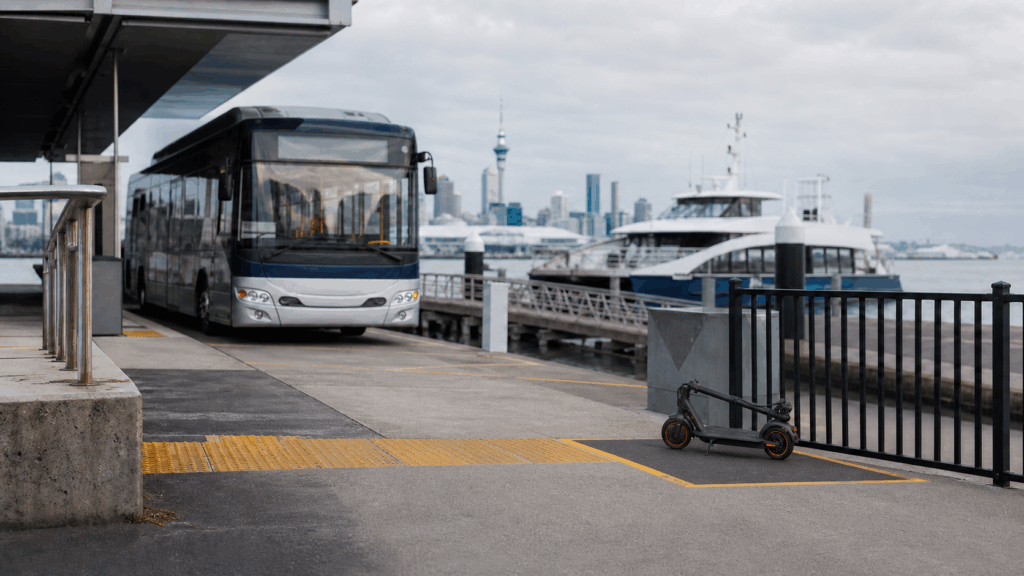
Auckland bus and ferry rules at a glance
| Service and scooter type | AT’s published position | Main conditions |
| Bus: compact foldable e-scooter | Permitted | Fold before boarding, store safely and keep folded |
| Bus: non-collapsible e-scooter | Not permitted under the bus Conditions of Carriage | NX1 rack instructions expressly cover bicycles and e-bikes, not e-scooters |
| Ferry: foldable e-scooter | Permitted subject to crew direction | Switch off and fold before boarding; store outside the cabin |
| Ferry: non-collapsible e-scooter | Conditional | Space, vessel capability and crew discretion apply |
| Ferry: any e-scooter | Onboard charging prohibited | The battery must remain enclosed and protected |
Taking an e-scooter on an Auckland bus
The detailed rule sits in AT’s bus Conditions of Carriage. It permits compact folding scooters, including electric ones. Folding is not something to do after stepping through the door: the document says it must happen before boarding.
Once inside, the scooter may be held between the legs of a seated passenger or put somewhere it can be stored safely. It stays folded until the passenger is off the bus. An aisle, doorway or emergency exit is never a storage place, even for a small device.
The accessibility area also needs care. AT says scooters and similar equipment must be removed when the space is required for a wheelchair or pram. In other words, an empty priority area may solve an immediate storage problem, but it does not become the scooter’s reserved space.
Drivers retain control over items brought aboard. They can refuse one when luggage space is full, or when its size or condition makes it hazardous. A passenger must also follow any direction about moving or holding the scooter.
What does AT mean by a “compact” scooter?
There is no published centimetre test for e-scooters. AT calls them “compact” and “folding”, but the measurements displayed on its bikes and public transport page are written for folding bicycles. Applying those figures to a scooter would turn a bicycle rule into one AT has not actually issued.
For an e-scooter, the text supplies a functional test instead: it folds before boarding, remains folded, and can be kept without obstructing anyone. That still leaves some judgement at the door. Where a device folds only partly or has no safe place onboard, the published luggage provisions allow the driver to say no.
What the NX1 rack guidance says – and does not say
This is the awkward part of AT’s public wording. The Bikes page says full-size bicycles and non-collapsible scooters are excluded from buses “except for NX1 buses”. The rack guidance immediately below, however, names full-size bicycles and e-bikes. Its loading limits and restraint instructions are also written for bicycles.
The longer bus conditions do not close that gap. They state that non-collapsible scooters cannot be brought onboard, then describe the NX1 equipment only as bicycle racks. No official instruction reviewed for this article explains how an e-scooter would be secured there.
That is not a sound basis for claiming rack permission. The restrained reading is that the rack guidance covers the devices it expressly names. Anyone seeking an NX1 exception for a non-collapsible e-scooter needs confirmation from AT, not an inference drawn from the position of a sentence on the webpage.
Taking an e-scooter on an Auckland ferry
The ferry Conditions of Carriage draws a clear line around the passenger cabin. A foldable e-scooter must be switched off and folded before boarding, then remain in that state until it is taken ashore. It is stowed on the deck, in a designated bicycle area or wherever the crew directs—not inside the cabin.
AT does not impose the bus prohibition on every non-collapsible e-scooter. The ferry document says carriage of those devices is subject to available space. It also leaves the final decision with the master and crew, taking the capability of the vessel into account. Different vessels and deck loads can therefore produce different decisions without changing the underlying rule.
Battery requirements are explicit. Charging onboard is prohibited. The battery must be secured inside its housing and not left exposed, so that it is protected from crushing or puncture. AT also limits carriage to a scooter belonging to the passenger; commercially operated scooters are excluded.
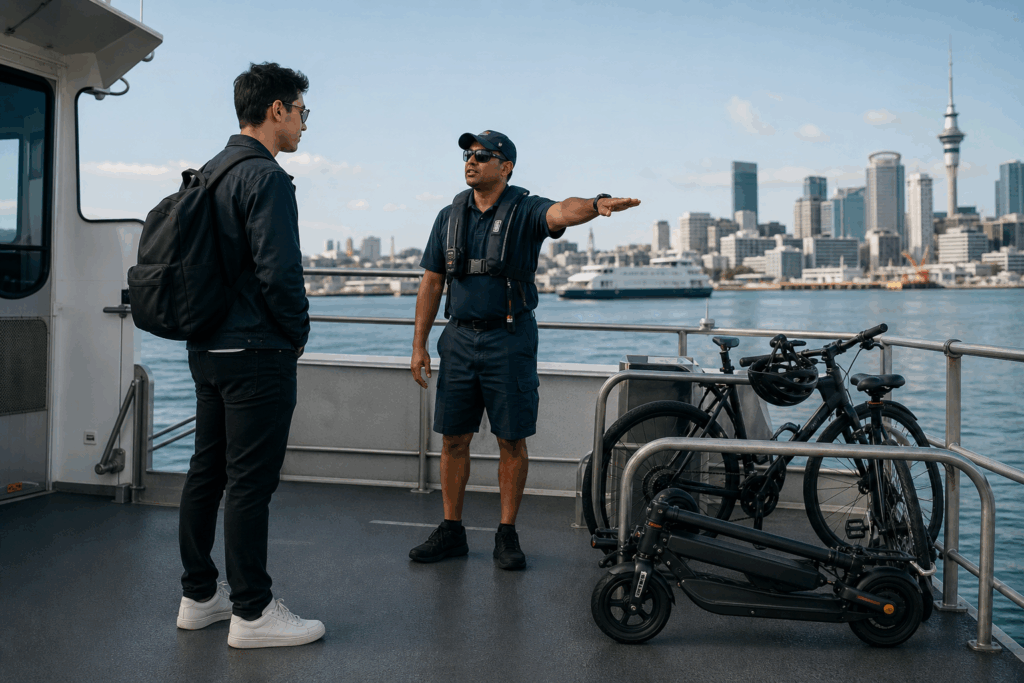
Ferry crew choose the safe storage location outside the cabin.
When can an e-scooter be refused?
An allowed category is not a booking for storage space. On a bus, refusal can follow when the scooter obstructs movement, when luggage space has filled, or when the item appears too large or unsafe. The driver has authority over its position onboard.
On a ferry, deck capacity and the layout of the vessel matter as well. The master or crew can decline carriage, and a battery with damaged or exposed housing would not meet AT’s stated condition. Previous acceptance on another service does not override the decision made at boarding.
Frequently asked questions
Can I take a foldable e-scooter on an Auckland bus?
Yes, if it is compact, folded before boarding and able to be stored safely. It remains folded onboard. The driver can still decline it when there is no suitable space or a safety concern arises.
Can I take a non-folding e-scooter on an AT bus?
The bus conditions say non-collapsible scooters cannot be brought onboard. AT’s public NX1 wording is not fully aligned with that document, and the rack instructions name bicycles rather than e-scooters. An NX1 exception should not be assumed without AT’s confirmation.
Can I take an e-scooter inside a ferry cabin?
No. AT places e-scooters outside the cabin: on the deck, in a designated bicycle area or in another position chosen by the crew.
Can a non-collapsible e-scooter go on an AT ferry?
It may be accepted when space is available and the master or crew considers the vessel capable of carrying it safely. Acceptance is conditional, not automatic.
Can I charge an e-scooter on an Auckland ferry?
No. The ferry conditions expressly prohibit charging an e-scooter onboard.
Are AT’s folding-bike dimensions also e-scooter limits?
No. AT publishes those dimensions for folding bicycles. Its scooter wording does not supply a separate numerical limit.
Check the current AT conditions before boarding
AT’s current Conditions of Carriage remain the controlling public documents. Recheck them before boarding, particularly after an operating update. Where the NX1 wording or an unusual device is not clearly covered, a direct answer from AT is more reliable than filling the silence with an assumption.
References
- Auckland Transport – Bikes and public transport
- Auckland Transport – Conditions of carriage
- Auckland Transport – Conditions of Carriage for bus services
- Auckland Transport – Conditions of Carriage for ferry services