
Portability is usually one of the first questions an NZ scooter buyer asks. With the HoneyWhale GT1, it is the wrong place to start.
This scooter weighs 41.55kg. It is unlikely to be carried upstairs each evening or folded beside a train seat. Its case rests on different hardware: two 1500W rated motors, a 67.2V / 29.4Ah battery, 12-inch tubeless tyres, hydraulic suspension and braking at both ends, and a steering damper mounted across the front assembly.
That combination gives the GT1 a clear job. It is our performance flagship for experienced buyers who have level storage, a suitable way to move a large scooter and a legally permitted environment for its output. Someone shopping for a compact last-kilometre machine should look elsewhere in the range.
We checked the HoneyWhale GT1 product page again on Jul 27, 2026. It showed the model available on backorder. The Auckland ETA displayed on the page had already passed, so we have not repeated it here. The live page remains the source for current stock and pricing.
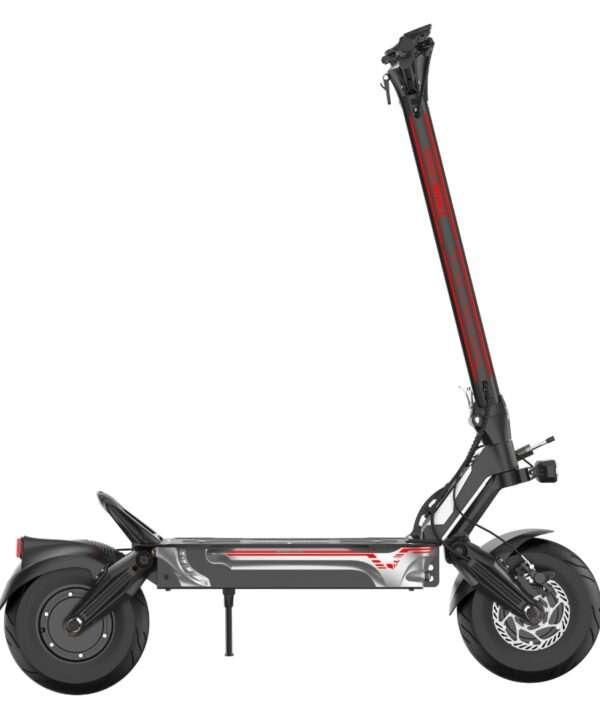
Official side-profile photography from the HoneyWhale GT1 product page.
What Is the HoneyWhale GT1?
The HoneyWhale GT1 is a full-size performance electric scooter with two 1500W rated motors and up to 4000W of combined peak output. The 67.2V / 29.4Ah battery, 12-inch tubeless tyres, hydraulic suspension and hydraulic brakes all contribute to its 41.55kg listed weight.
That weight changes ownership before the first ride. A buyer needs enough room to turn and store the scooter, level access where possible, and a realistic plan for transport if it ever needs to go into a vehicle or back to a workshop.
Compact commuters allocate more of their design to carrying, folding and short urban connections. The GT1 allocates more to battery capacity, chassis, tyre size, suspension and braking. Neither approach is universally better. They solve different trips.
HoneyWhale GT1 Specifications at a Glance
The figures below come from the live GT1 product page and were checked on Jul 27, 2026. Speed and range are stated as “up to” figures; actual results depend on settings, rider load, terrain, weather and riding style. The two-port charging and damper-adjustment details were supplied separately by HoneyWhale’s product team and are identified below.
| Feature | HoneyWhale GT1 |
| Motor system | Dual motor, switchable between single and dual drive |
| Rated motor output | 3000W combined, 1500W per motor |
| Peak motor output | Up to 4000W combined, 2000W per motor |
| Listed top speed | Up to 100km/h in unrestricted mode |
| Listed range | Up to approximately 100km per charge |
| Battery | 67.2V / 29.4Ah lithium-ion |
| Charging | Up to 8 hours listed; two charging ports confirmed by HoneyWhale’s product team |
| Tyres | 12-inch tubeless |
| Suspension | Front and rear hydraulic suspension |
| Steering control | Steering damper listed; adjustable resistance confirmed by HoneyWhale’s product team |
| Brakes | Front and rear hydraulic brakes |
| Lighting | Headlight, indicators and LED atmosphere lighting |
| Water-resistance rating | IPX5 |
| Maximum listed load | 150kg |
| Scooter weight | 41.55kg |
These figures help establish the GT1’s category, but no specification table can tell a rider exactly how far a particular trip will go or how a scooter will feel on a particular surface. A heavier rider, repeated acceleration, steep climbs, cold weather and higher-speed riding all ask more from the battery.
We would rather make that limitation clear than turn an “up to” figure into a promise it was never meant to be.
What Makes the GT1 Different From an Everyday Electric Scooter?
The 4000W peak figure is the obvious difference, but it is not useful in isolation. A rider still has to control the scooter’s mass, maintain tyre grip and slow the machine predictably. Read the GT1’s motors, steering damper, tyres, suspension and brakes as one system rather than as separate numbers on a product page.
A dual-motor system with a broader operating range
Each motor is rated at 1500W, and the product page lists up to 4000W combined peak output. The rider can select single- or dual-motor drive. For the intended buyer, the practical value is headroom under load and on climbs in an appropriate environment—not an invitation to use maximum output everywhere. Throttle judgement still matters, especially at low speed or on loose ground.
Hydraulic suspension at the front and rear
Broken chipseal, driveway lips and uneven private accessways can pass sharp impacts through a small, stiff scooter. The GT1 uses hydraulic suspension at the front and rear to manage those movements. It cannot rescue a poor line through a pothole or create grip where the surface has none, but it gives this heavier platform more control hardware than a basic urban spring setup.
An adjustable steering damper
Look closely at the front of the GT1 and there is a small damper running across the steering assembly. It adds resistance to sudden handlebar movement. HoneyWhale’s product team says that resistance can be adjusted to suit the rider’s preference.
Why include it? A rapid steering oscillation — often called speed wobble by riders — can build more quickly than expected on a small-wheeled two-wheeler. E-scooter stability is a recognised design issue. The UK Department for Transport’s technical research into e-scooter construction standards reviews steering-flutter testing and technical steering-stabilisation measures, although it does not test the GT1 or its damper.
The damper is an extra layer of steering control, not a promise that wobble cannot happen. Tyre pressure, stem and folding fasteners, the road surface, speed and rider input still matter. A setting that feels composed in one situation can also feel too heavy in another, so adjustment should follow the product instructions or workshop advice rather than guesswork.
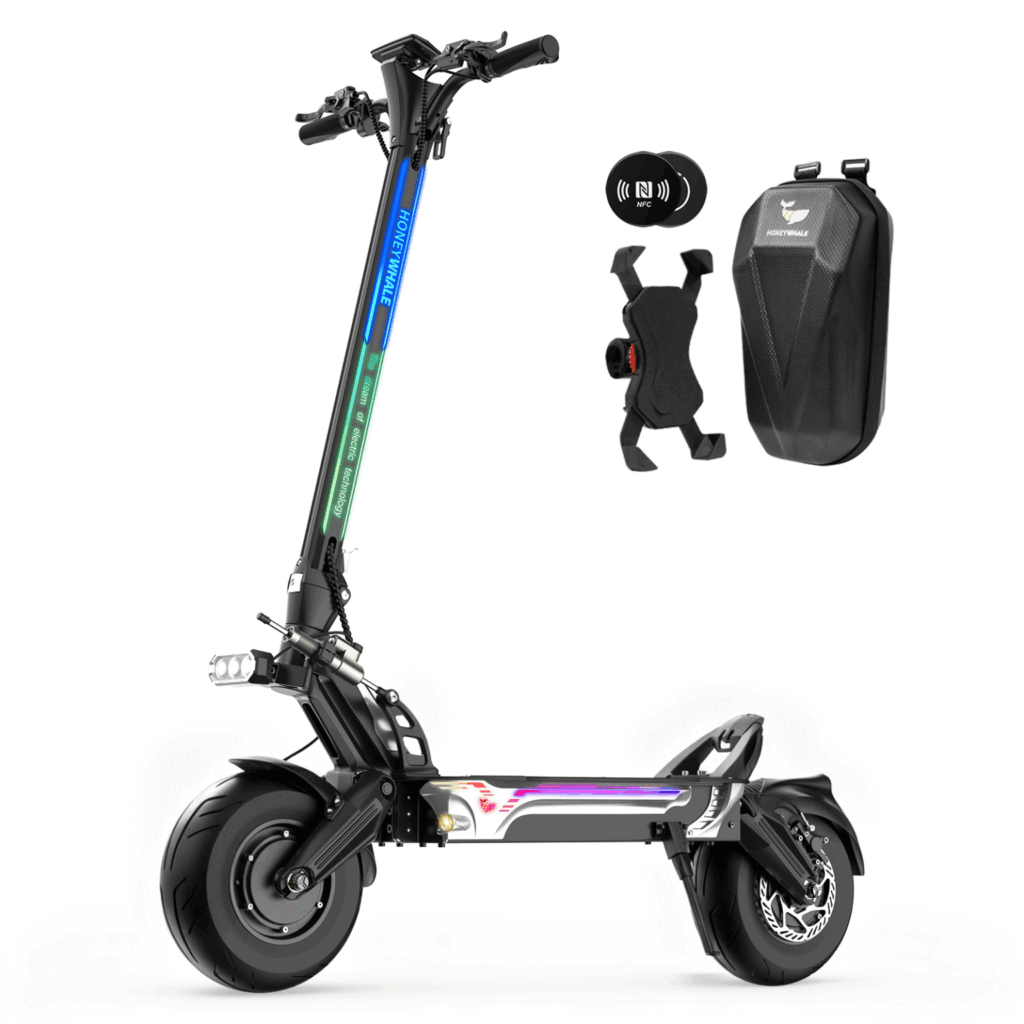
The steering damper is visible above the front suspension assembly. The same official GT1 image also shows the illuminated stem and deck trim. Source: HoneyWhale GT1 product page.
Hydraulic braking on both wheels
The GT1 also uses front-and-rear hydraulic brakes. On a scooter of this weight and output, braking hardware is not an accessory to the performance story. It is central to it.
Before a ride, confirm that both brakes bite consistently, the tyres are holding pressure and nothing has loosened around the stem or folding hardware. Our Maintenance & Care guide explains the checks in more detail. A 41.55kg scooter with this output leaves little room for neglected pads, soft tyres or loose controls.
Twelve-inch tubeless tyres and a full-size frame
The GT1 uses a larger-diameter 12-inch tyre format, compared with the GT1 Mini’s listed 11-inch tyres. The overall platform is correspondingly substantial. At 41.55kg, repeated stair carrying or a daily train transfer is unrealistic for most riders.
Before ordering, trace the actual route from storage to the riding area. A tight turn, doorstep, stair or awkward vehicle lift can matter more in daily ownership than another line in the specification table.
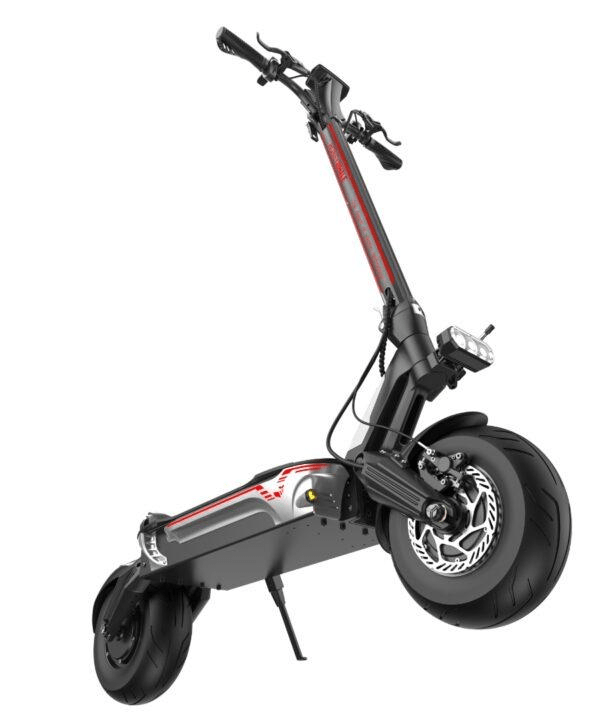
Front-wheel, hydraulic brake and suspension hardware on the HoneyWhale GT1. Source: HoneyWhale GT1 product page.
Multicolour ambient lighting
The live specification also lists LED atmosphere lighting. On the GT1, the coloured stem and deck illumination gives the scooter a distinctive after-dark look. The product-gallery artwork states that these ambient lights can be controlled separately. They are visual features, not substitutes for the headlight, indicators, reflective gear or careful positioning around other people.
Who Is the HoneyWhale GT1 Designed For?
The GT1 makes the most sense for a rider who already understands the practical side of owning a performance scooter.
That may include:
- experienced riders moving up from a smaller platform;
- riders who want a larger battery and more substantial chassis;
- heavier riders looking for a model with a listed 150kg load capacity;
- buyers with secure, accessible storage and room for a 41.55kg scooter;
- performance enthusiasts using private property or another legally permitted environment; and
- customers who value local access to parts, maintenance advice and repair support.
It is probably not the right first choice for someone who mainly needs a light scooter for a short connection to public transport. It is also more machine than many urban riders need for a simple trip to the shops.
That is not a weakness. A flagship product becomes more useful when its role is clear.
What Does “Up to 100km” Mean in Real Riding?
The GT1 product page lists up to approximately 100km per charge. Treat that number as a ceiling under favourable conditions, not a route plan.
A 41.55kg scooter carrying a rider uphill into a cold headwind, with repeated acceleration in dual-motor mode, will not reproduce a gentle and steady test run. Rider and cargo weight, tyre pressure, temperature and stop-start frequency all change the result.
The useful question is therefore not simply, “Can it reach 100km?” It is, “How much reserve will I have for my own route and riding style?”
We recommend planning with margin rather than building a trip around the last kilometre of a claimed maximum. Buyers who need help matching battery capacity to a route can contact the HoneyWhale NZ team before choosing a model.
HoneyWhale’s product team also confirms that the GT1 has two charging ports, so two compatible chargers can be used when a quicker turnaround is needed. The public listing currently gives an “up to 8 hours” charging figure but does not publish a separate two-charger time, and a second charger should not be assumed to be included. Use only HoneyWhale-supplied or specifically approved compatible chargers, connect them as instructed and stop charging if a plug, port or battery shows damage or unusual heat.
A Performance Specification Is Not Permission to Ride Anywhere
This distinction matters.
Electrical certification, product quality and public-road classification are different questions. One does not automatically answer the others.
NZ Transport Agency Waka Kotahi states that the e-scooters covered by New Zealand’s no-registration, no-driver-licence framework must have combined maximum motor output not exceeding 300W. NZTA also lists e-scooters above 300W among powered vehicles that have difficulty meeting the relevant road requirements and says they cannot be operated on the road. The underlying E-Scooters (Declaration Not to be Motor Vehicles) Notice 2023 applies only when its listed design conditions are met and combined motor output does not exceed 300W; the notice expires on Sept 30, 2028.
The GT1’s product specification is far above that 300W threshold. Its NZ default speed setting does not by itself remove the need to consider its rated motor output and legal classification. Unrestricted modes are intended for private property or places where that use is legally permitted.
Before riding, buyers should check current official guidance and our New Zealand Rules & Regulations page. Do not assume that a performance scooter can be used on a public road, footpath or cycle facility simply because it has a selectable speed mode.
Electrical Compliance and New Zealand Ownership Support
The GT1 product page identifies EESS registration, SAA approval and Global-Mark certification for the scooter’s electrical compliance pathway. We explain the role of those systems in our separate guide to HoneyWhale electrical safety certification.
The EESS Registration Database explains the wider system: it records responsible suppliers, declarations and brand-and-model details for relevant equipment, while also giving the public a way to check registration and certification information. That is useful context for understanding why a certification claim should be tied to a specific supplier and model rather than treated as a general badge.
That compliance work is separate from riding legality, but it remains an important ownership consideration. A performance scooter brings together a high-capacity battery, charger, controllers, wiring and two motors. Buyers deserve clear information about the electrical product as well as its mechanical features.
WorkSafe New Zealand’s lithium-ion battery guidance recommends using the original charger, not charging a damaged battery, avoiding unattended overnight charging and keeping the charging area clear of flammable materials. Those controls matter for any e-scooter and deserve particular attention around a high-capacity battery system.
Support after purchase matters for similar reasons. HoneyWhale publishes its current warranty terms, including component-specific coverage and exclusions, rather than reducing the policy to a single headline number. Auckland and Christchurch service options, parts support and remote assistance are available through our NZ team; the scope of any repair or warranty claim is assessed under the published terms.
GT1 or GT1 Mini?
The GT1 is the full flagship. The HoneyWhale GT1 Mini follows the same performance direction in a smaller, lighter and lower-output package.
“Mini” describes the comparison with the GT1, not the commuter category. The GT1 Mini is still a 34.75kg scooter with 2400W of combined rated output. Its 11-inch tyres and 58.8V / 18.2Ah battery reduce the scale, but they do not turn it into something designed for daily lifting onto public transport.
The accompanying HoneyWhale GT1 vs GT1 Mini comparison sets out the decision field by field. The simple version is this: choose the GT1 for the range’s largest battery, highest output and most substantial platform; consider the GT1 Mini when relative manageability matters more than maximum specification.
The GT1’s Place in the HoneyWhale Range
The GT1 is not designed to be the answer to every electric scooter question.
It is our answer for a specific buyer: someone looking for the top end of the HoneyWhale performance range, who understands the responsibilities that come with the scooter’s output and size.
If that description fits, explore the full HoneyWhale GT1 specifications and talk to our team about storage, intended use and support before ordering. If it does not, a lighter commuter or intermediate model may make more sense — and choosing the scooter that genuinely fits the job is always the better outcome.
References
- HoneyWhale GT1 product page
- HoneyWhale GT1 Mini product page
- NZ Transport Agency Waka Kotahi: Low-powered vehicle requirements
- New Zealand Gazette: E-Scooters (Declaration Not to be Motor Vehicles) Notice 2023
- WorkSafe New Zealand: Safe use of lithium-ion batteries and battery products
- Electrical Equipment Safety System: EESS Registration Database
- UK Department for Transport: Technical research into construction standards for e-scooters
- HoneyWhale electrical safety certification guide
- HoneyWhale Maintenance & Care
- HoneyWhale Warranty Policy