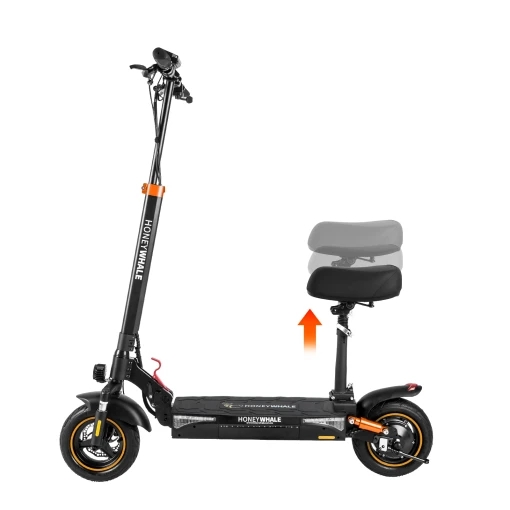

A product page gives you one clean range number. A winter commute is rarely that neat.
By the time you ride home, the scooter may be carrying a laptop, a lock, rain gear and a few groceries. The return leg might include a headwind or the steeper side of the route. Tyre pressure may have slipped since the last check. None of those details appears beside the advertised range, but each one changes what the battery has to do.
That is why a shorter-than-expected trip is not, by itself, evidence of a bad battery. First compare the trip with the conditions behind the published figure. Then look at the scooter, the route and the way it was ridden.
For NZ riders, winter brings several of those variables together. Mornings are colder, roads are wetter, lights stay on longer and exposed routes can be windy. The useful question is not “What is the exact winter range?” It is “How much of this scooter’s range can I sensibly plan around on my route?”
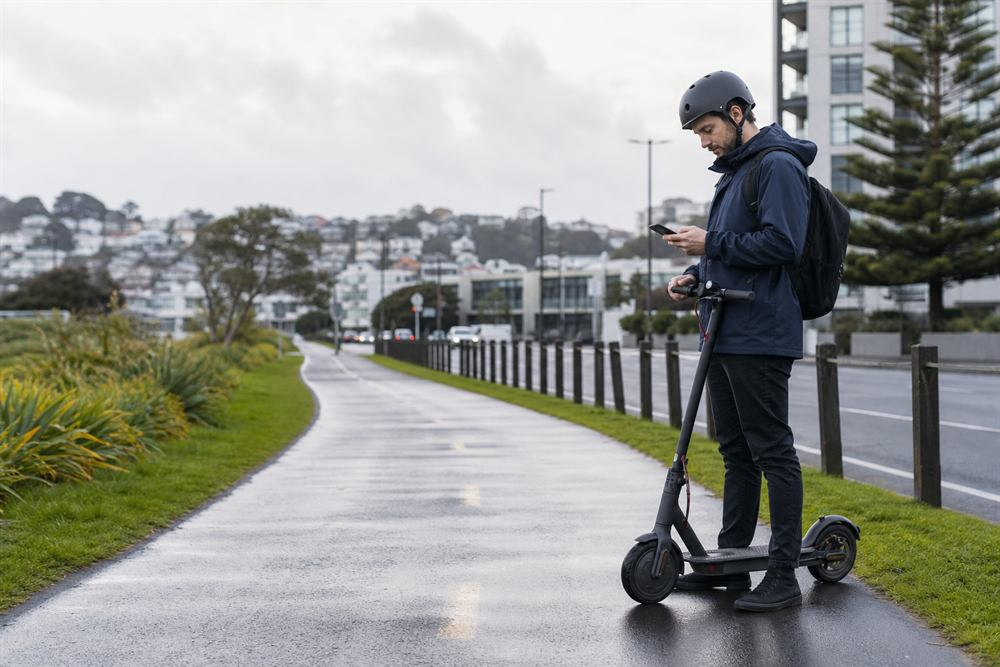
Planning the full return route makes an advertised range figure more useful.
What an “up to” range figure tells you
An advertised range is best used as a reference point between models. It is not a promise that every rider will travel that distance.
HoneyWhale’s Terms & Conditions explain that the maximum speed, range and climbing figures on the website are based on a rider weighing 50–60kg. They also note that performance changes with rider weight and other conditions. That test basis matters. A rider plus a work bag can be considerably heavier, while a real commute may add hills, wind and frequent starts.
Maximum load and maximum range are also different specifications. The first tells you the listed weight limit. It does not say that the scooter will reproduce its longest range while carrying that load.
Read the published figure as the top of a planning envelope. If your return journey only just fits inside it on paper, the route has no margin for weather, detours or normal variation. That is a fragile commute plan.
Why colder weather can affect a lithium-ion battery
The chemistry inside a lithium-ion battery responds to temperature. In colder conditions, ions move less readily and internal resistance rises. The practical result can be less available power or energy during the trip, even though the battery has not suddenly lost the same amount of permanent capacity.
The US Department of Energy discusses cold-weather performance challenges for electric-vehicle batteries and recommends beginning winter travel with adequate charge. Pacific Northwest National Laboratory has also described how temperature extremes reduce the efficiency of conventional lithium-ion batteries.
A 2025 National Renewable Energy Laboratory assessment of electric vehicles in Alaska gives a more technical account of the process, including slower ion mobility and greater internal resistance in the cold. That work concerns full-size vehicles in far harsher conditions than a typical New Zealand scooter commute. It supports the battery principle; it does not provide a percentage that should be copied onto every e-scooter.
There is no credible universal rule that all scooters lose the same share of range in a New Zealand winter. Battery chemistry, age, storage temperature, route and riding style vary too much. A scooter kept indoors overnight may start its morning journey quite differently from one left in a cold shed.
The route usually matters as much as the weather
Two riders can leave with the same model and the same displayed charge, then return with very different battery readings.
One rider travels steadily along a flat waterfront path. The other carries a heavy bag, climbs from the station, stops at several crossings and accelerates hard each time. Calling those two trips the same “distance test” misses most of what the motor was asked to do.
Keep these factors together when judging range:
| Trip factor | What changes |
| Rider and cargo | More mass must be accelerated and moved uphill |
| Hills and repeated starts | The motor draws more energy than it does during steady, flat travel |
| Higher speed | Air resistance and power demand rise |
| Low tyre pressure | Rolling resistance increases |
| Headwind or wet roads | The scooter works against extra resistance and the rider may vary speed more often |
| Colder battery | Usable performance may be reduced while the pack is cold |
| Battery condition | Available capacity can change with age, storage and damage |
This is not a calculator. It is a way to explain why a single kilometre figure cannot describe every trip.
Remember the bag, not just the rider
Winter commuting adds weight in quiet ways. There is the laptop, charger, lunch, lock, waterproof layer and perhaps shopping on the return leg. It all moves with the scooter.
Extra load becomes most noticeable during starts and climbs. On a level route with long uninterrupted sections, the difference may feel modest. On a hilly urban route, the motor repeatedly has to bring the combined load back to speed.
If you are choosing a scooter, do not match its listed maximum range exactly to the return distance. Give the route room for the load you actually carry.
Hills, speed and riding style
A map can tell you that work is eight kilometres away. It cannot tell you whether those kilometres are flat, exposed, steep or interrupted by crossings.
Uphill travel spends energy gaining elevation. Coming down reduces motor demand, but do not plan on recovering everything used during the climb. Some scooters have electronic or regenerative braking; the amount recovered depends on the system and the ride.
Speed produces another trade-off. Hard acceleration and sustained high-output riding use more energy than a steady pace. On a scooter with several modes, ride the real return route a few times before deciding which mode is practical. The quickest setting is not automatically the best commuting setting.
For a new or demanding route, begin conservatively. Arrive home with charge left, note the conditions, then learn from several trips rather than treating one ride as a definitive test.
Check the tyres before diagnosing the battery
When a scooter feels heavy or slow, tyre pressure is one of the quickest things to inspect.
HoneyWhale’s Maintenance & Care guide recommends checking tyre pressure, cracking and wear every two weeks or every 200km. It also directs riders to look at tyre pressure when a scooter feels unusually slow. NZTA’s general tyre guidance, written for cars, links correct inflation with handling and energy efficiency. The vehicle is different, but the rolling-resistance principle is the same.
A soft pneumatic tyre flexes more as it rolls. The motor then works against that extra resistance. Because cooler weather and falling pressure can arrive at the same time, it is easy to blame the battery for the entire change.
Use the pressure specified for the model and tyre. If pressure repeatedly falls, look for a puncture, valve problem or damage rather than making top-ups the permanent routine.
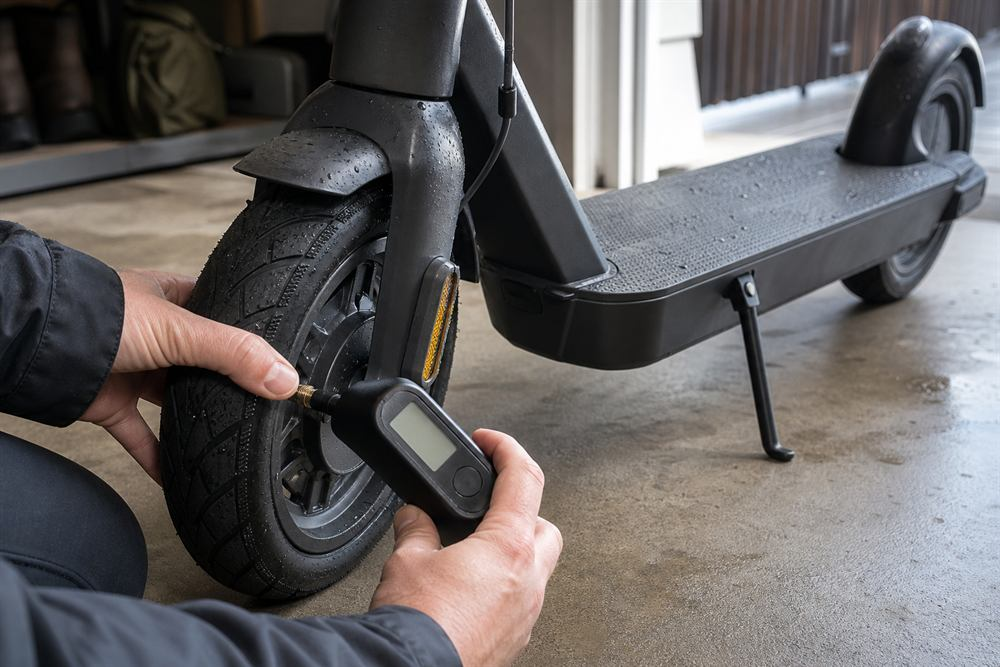
Tyre pressure is a quick mechanical check when a scooter begins to feel slow or heavy.
Wet roads alter the trip as well
Rain does not automatically cut a fixed number of kilometres from the display. It changes the journey in smaller ways.
You may slow for painted markings, brake earlier, use lights throughout the trip or take a longer route around standing water. Grime can collect near the wheels and brakes. A dragging brake or neglected tyre then adds resistance that has nothing to do with battery chemistry.
After a wet ride, HoneyWhale’s care guidance says to dry the scooter rather than store it wet. Clean it with a damp cloth; do not direct water at the battery or motor. Let the scooter and charging area dry before plugging it in.
Water resistance is a design limit, not a licence to ride through deep puddles or treat the scooter as waterproof.
How to build a useful range reserve
No single reserve percentage suits every journey. A short flat ride near home is not the same risk as a long evening return with hills and nowhere to recharge.
The important part is to stop planning routine trips around an empty battery. Measure the full return route, including the detour you often make rather than the perfect route shown on a quiet-day map. Then watch how the scooter behaves across several comparable rides.
For the first attempts:
- Start with adequate charge and follow the model’s charging instructions.
- Use a moderate mode instead of testing maximum performance.
- Note the rider-and-bag load, temperature, wind and remaining display at the end.
- Repeat the route before treating one result as normal.
- Use the less favourable result when planning the next cold or windy day.
Battery displays are estimates. They do not always fall evenly under load, especially near the bottom of the gauge. Seeing 20% does not guarantee that exactly one fifth of the original kilometres remains.
When reduced range deserves support
Some variation between a mild flat ride and a cold hilly one is ordinary. A sudden change under similar conditions deserves attention.
Pause longer trips and seek model-specific advice if the scooter stops charging normally, becomes unusually hot, develops a chemical or burning smell, shows swelling or smoke, has suffered significant water or impact damage, or loses far more range without a change in route, load or weather.
Mechanical resistance can also be responsible. A tyre that will not hold pressure, a dragging brake or a wheel that no longer turns freely should be checked before the battery is blamed.
Do not open a lithium-ion battery pack or improvise a charger. Use equipment approved for the model. HoneyWhale owners can follow the Maintenance & Care guidance for routine checks and contact the NZ support team when the behaviour is outside normal maintenance.
A winter routine that is actually useful
Before a longer commute, check the round-trip distance, tyres and expected weather. Include what is in the bag. Leave enough charge for the return, not merely enough to reach the destination. After a wet trip, dry the scooter before storage or charging.
Most importantly, compare like with like. A cold ride into a headwind is not a fair comparison with a mild weekend run on a flat route. If performance changes sharply across genuinely similar trips, that is the moment to investigate.
The advertised figure still has value. It tells you something about the model’s capacity under stated conditions. Your own repeat journeys tell you what portion of that capacity is dependable for your commute.
If you are still choosing a model, explore the current HoneyWhale electric scooter range and buy for the real return route, with reserve, rather than for the last kilometre of an “up to” claim.
References
- HoneyWhale Terms & Conditions. Accessed 28 July 2026.
- HoneyWhale Maintenance & Care. Accessed 28 July 2026.
- US Department of Energy: Winterizing Your Electric Vehicle. Published 30 January 2024.
- Pacific Northwest National Laboratory: Scientists Widen the Temperature Range for Electric Car Batteries. Published 4 October 2019.
- National Renewable Energy Laboratory: Electric Vehicle and Charging Infrastructure Assessment in Cold-Weather Climates. Published 2025.
- NZ Transport Agency Waka Kotahi: Tyres. Accessed 28 July 2026.