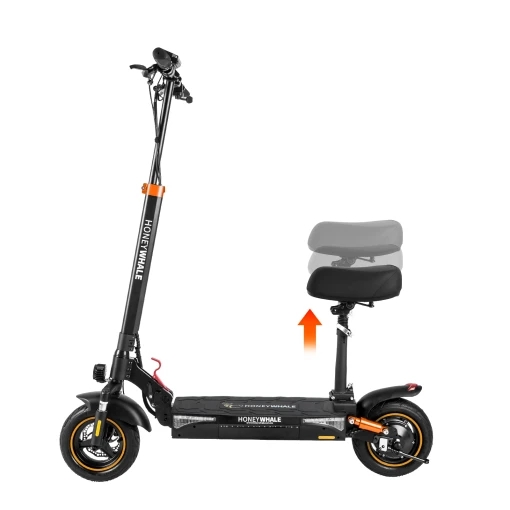

How to Choose an Electric Scooter for Commuting in New Zealand
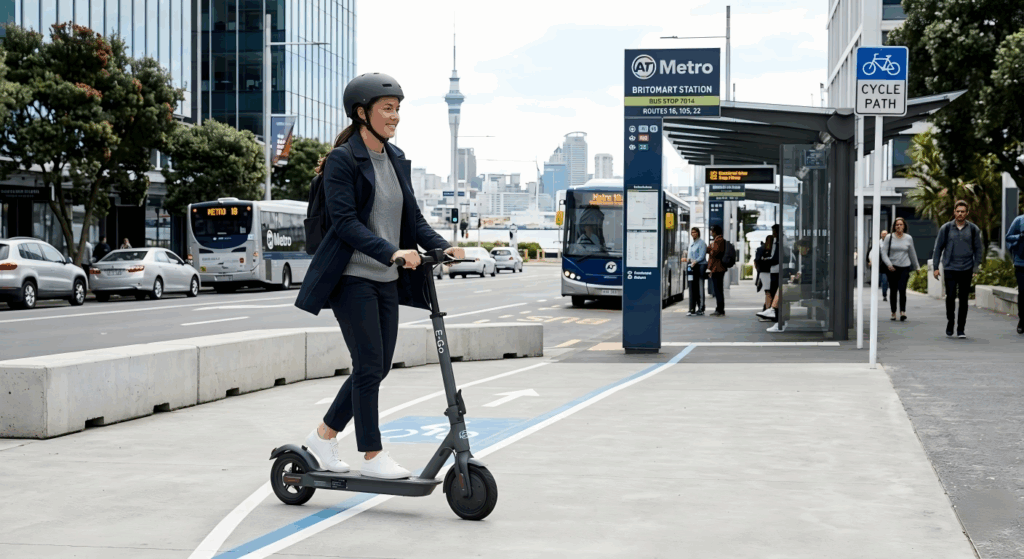
For many riders in New Zealand, the real question is not whether an electric scooter looks exciting. It is whether it makes everyday travel easier.
That is the shift that changes everything.
Once a scooter becomes part of your weekday routine, the question is no longer “What looks best on paper?” It becomes “What will still make sense on a normal Tuesday?” That shift matters because daily use exposes every weak point — awkward carrying, limited comfort, overbuilt weight, or features that sound exciting but do not actually improve the ride.
That broader context also fits how transport planners in New Zealand now talk about micromobility. NZTA’s Public Transport Design Guidance places bikes and micromobility within the wider access journey to and from public transport, rather than treating them as separate from it (NZTA, n.d.).
In other words, a commuter scooter makes the most sense when it solves a repeat problem in your week.
Not when it just looks impressive for five minutes online.
Why Commuting Changes the Way You Should Choose an E-Scooter
There are plenty of reasons someone might end up shopping for an electric scooter. For some people, it starts with a short trip that feels annoying on foot. For others, it is about cutting out little car journeys that do not feel worth the trouble.
But commuting changes the conversation.
Once a scooter becomes part of your weekday routine, the question is no longer “What looks best on paper?” It becomes “What will still make sense on a normal Tuesday?” That shift matters because daily use exposes every weak point — awkward carrying, limited comfort, overbuilt weight, or features that sound exciting but do not actually improve the ride.
That broader context also fits how transport planners in New Zealand now talk about micromobility. NZTA’s Public Transport Design Guidance places bikes and micromobility within the wider access journey to and from public transport, rather than treating them as separate from it (NZTA, n.d.).
In other words, a commuter scooter makes the most sense when it solves a real movement problem, not when it is treated as a standalone novelty.
What a Real Daily Commute Actually Looks Like
A real commute is rarely as neat as a product description.
One rider may only need a scooter for a quick run to the station. Another might be covering several kilometres through city traffic, patched road surfaces, and multiple stops. Someone living in an apartment may care more about storage and carrying than speed. Someone riding farther every weekday may stop caring about weight first and start caring about fatigue instead.
That is why “best commuter scooter” is such a slippery phrase. The better question is simpler: what does your route ask from you, over and over again?
That question matters because commuting is not an occasional use case. Stats NZ’s Commuter Waka, which draws on 2018 and 2023 Census commuter data, is a reminder that work and education travel remain a major part of everyday movement in Aotearoa New Zealand (Stats NZ, 2025).
And once you think in those terms, buying by routine starts to make a lot more sense than buying by headline numbers.
Quick Self-Check: What Kind of Commuter Are You?
| If this sounds like you… | Your commute usually demands… | Your decision priority |
| “My trip is short, simple, and mostly predictable.” | Easy daily handling, practical range, low hassle | E9 Pro, E9T, E9 Max, E9 Max N |
| “I ride to a station and deal with transitions every day.” | Smooth carrying and storage | E9 Pro, E9T, E9 Max |
| “My route is longer or rougher than it looks on paper.” | Less fatigue over repeated rides | M1 Max, M2 Max, M2 Max B, G2 Pro |
| “I need something balanced, not extreme.” | A mix of carry convenience and ride quality | M1 Max, M2 Max, G2 Pro |
How Much Range Do You Really Need?
Range matters. It just does not always matter in the way people expect.
A lot of shoppers assume that more battery automatically means a better commuter scooter. Sometimes it does. Often it just means more cost and more weight. If your weekday route is short, predictable, and mostly urban, you may not gain much from stretching into a larger category. If your ride is longer, rougher, or you simply want more breathing room between charges, the extra battery can be worth it.
That is the trade-off.
The useful question is not “What is the biggest number I can afford?” It is “What do I actually need five days a week?” NZTA’s micromobility guidance is relevant here because it frames micromobility as part of access to public transport, which naturally aligns with many short and medium daily trips rather than every ride requiring a long-range setup (NZTA, n.d.).
For commuting, honesty is more useful than ambition.
Why Portability Matters More Than Most Buyers Expect
Portability sounds like a minor detail until you live with it.
It shows up when you get to a station gate, when you drag the scooter through a doorway, when you lift it into a building foyer, or when you realise that “light enough” in theory still feels awkward in your hands after a long day.
That is why portability is not just about listed weight. It is about how the scooter behaves when the ride pauses. Foldability matters. Balance matters. Even the way a scooter feels to manoeuvre indoors matters more than many buyers realise at the start.
This becomes even more relevant when commuting overlaps with public transport. Auckland Transport says that full-sized bicycles and non-collapsible scooters cannot be taken on most buses except NX1 services, including electric bikes and scooters (Auckland Transport, n.d.).
So yes, portability is partly about convenience.
But in some routines, it is also about whether the commute works at all.
Comfort and Stability Matter More Than Top Speed
Top speed is easy to notice. Comfort takes longer.
You usually do not understand ride quality on the first look. You understand it after a week of rougher corners, patched streets, longer standing time, and the kind of ordinary weekday riding that never appears in a spec sheet.
That is why a scooter that feels planted and calm can end up being the better commuter choice, even if it looks less exciting at first glance. Most weekday riders are not chasing one dramatic ride. They are trying to avoid the slow build-up of annoyance, fatigue, and second thoughts.
And that is where many buying decisions quietly change.
The scooter that feels easier to live with often wins.
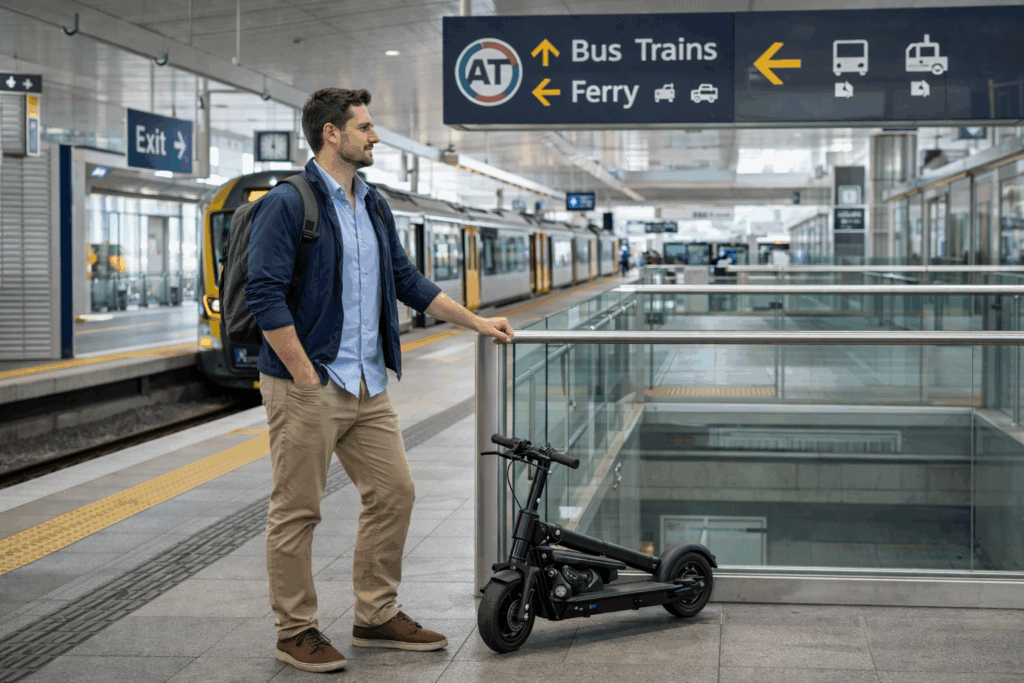
Choosing for Train-and-Last-Mile Travel
Train-and-last-mile travel deserves its own category because it asks different things from a scooter.
In that setup, the scooter is not only something you ride. It is also something you fold, guide, carry, store, and fit around a wider public transport journey. NZTA’s guidance explicitly supports this role by positioning bikes and micromobility as ways to extend access to public transport stops and stations (NZTA, n.d.).
That is where portability moves much higher up the priority list.
If your ride to the station is short but you handle the scooter several times a day, daily convenience may matter more than extra range you rarely use. Auckland Transport’s bus guidance reinforces this practical point because non-collapsible scooters are not broadly accepted on buses, which means compactness and foldability can directly shape what kind of mixed commute is realistic (Auckland Transport, n.d.).
In other words, the best train-and-last-mile scooter is often not the one with the boldest spec sheet. It is the one that fits the interruptions between rides.
Mixed-Commute Realities at a Glance
| Mixed-commute reality | What it means for the rider | Source |
| Micromobility can extend access to public transport | A scooter can work well as part of first- and last-mile travel | (NZTA, n.d.) |
| Non-collapsible scooters cannot be taken on most buses except NX1 services | Foldability can directly affect whether a routine works | (Auckland Transport, n.d.) |
| Secure parking matters near destinations and stations | Commuter fit includes what happens after the ride ends | (Auckland Transport, 2026) |
Storage, Parking, and the Reality of Daily Ownership
Commuting does not really stop when the wheels stop.
You still have to decide where the scooter goes, how you lock it, whether it fits into the rest of your day, and how much mental effort that routine takes over time. This is one of the least glamorous parts of ownership, but it has a big effect on whether commuting by scooter still feels convenient a month later.
Auckland Transport’s bike parking and security guidance is useful here because it explicitly includes bikes and e-scooters. AT notes that Locky Docks provide secure parking for bikes and e-scooters, and also recommends practical steps such as recording your serial number and using Project 529 (Auckland Transport, 2026).
That may sound like a small operational detail. It is not.
For commuters, parking and storage are part of product fit, not an afterthought.
Which Type of Commuter Scooter Fits Your Routine?
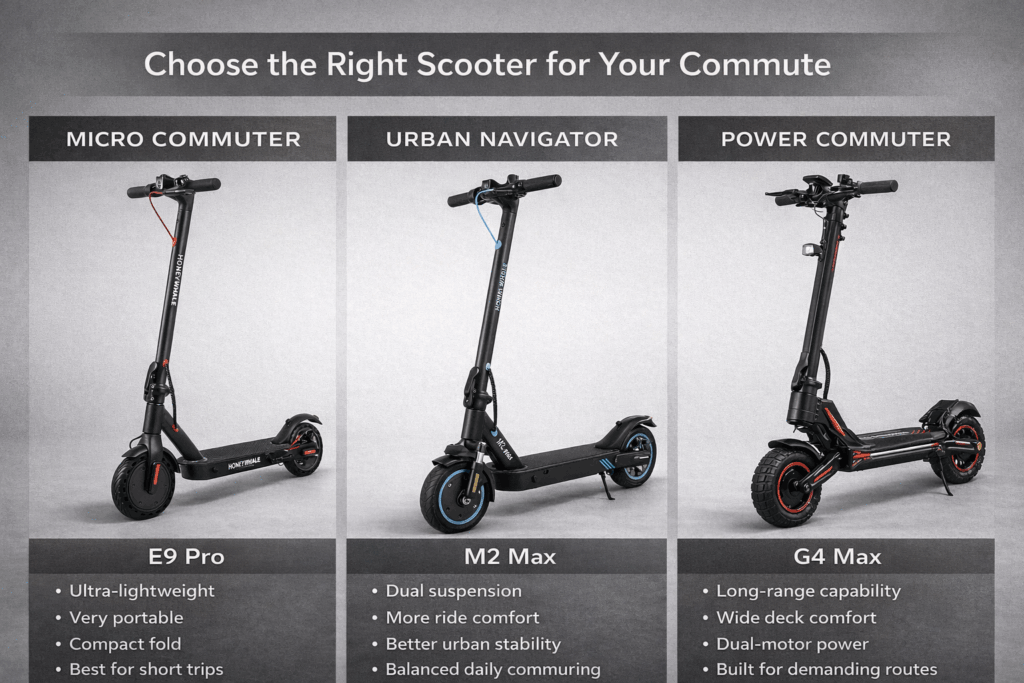
At this point, the right question is no longer whether one scooter is “best” in the abstract. It is which type of scooter makes the most sense for the way you actually travel.
Some routines reward simplicity. Some punish poor portability. Some make comfort the deciding factor surprisingly quickly.
That is where a clearer model breakdown becomes useful.
| Commuting routine | What matters most | Recommended HoneyWhale models | Why they fit |
| Short, simple weekday commuting | Easy handling, practical range, low hassle | E9 Pro, E9T, E9 Max, E9 Max N | A good fit for riders who want a lighter, more straightforward commuting option |
| Mixed commuting with public transport | Foldability, portability, easy transitions | E9 Pro, E9T, E9 Max | Better suited to station access and routines that involve carrying or storing the scooter more often |
| Balanced urban commuting | A mix of portability and ride comfort | M1 Max, M2 Max, M2 Max B, G2 Pro | A sensible middle ground for riders who want more comfort without jumping straight to a heavier class |
| Longer or rougher weekday routes | Comfort, stability, lower fatigue | T4-B, T4B-N, T8, T8 Max, G4 Max | Better for riders whose routes are more demanding and who care more about ride feel than portability |
A Simple Checklist Before You Buy
| Buying question | Why it matters |
| How far do you actually travel on a normal weekday? | It keeps range decisions realistic |
| Will you carry the scooter regularly? | It affects how important portability really is |
| Is your route smooth or tiring? | It changes how much comfort and stability matter |
| Does your commute include public transport? | It affects whether foldability becomes essential |
| Where will you store or secure it every day? | Ownership convenience shapes long-term satisfaction |
Before you choose a commuter scooter, slow the decision down and answer those questions honestly.
The best electric scooter for commuting in New Zealand is rarely the one with the loudest headline. It is the one that keeps making sense once the routine becomes ordinary.
That is usually the better purchase.
References
Auckland Transport. (2026, February 1). Bike parking and security. https://at.govt.nz/cycling-walking/bike-parking-security/
Auckland Transport. (n.d.). Bikes & public transport. https://at.govt.nz/bus-train-ferry/luggage-bikes-animals/bikes-public-transport/
New Zealand Transport Agency Waka Kotahi. (n.d.). Overview. In Public Transport Design Guidance. https://nzta.govt.nz/walking-cycling-and-public-transport/public-transport/public-transport-framework/integrated-planning-and-design/public-transport-design-guidance/overview/
New Zealand Transport Agency Waka Kotahi. (n.d.). People on bikes and micromobility. In Public Transport Design Guidance. https://nzta.govt.nz/walking-cycling-and-public-transport/public-transport/public-transport-framework/integrated-planning-and-design/public-transport-design-guidance/getting-to-and-from-public-transport/people-on-bikes-and-micromobility/
Stats NZ. (2025). Commuter Waka. https://www.stats.govt.nz/tools/commuter-waka/